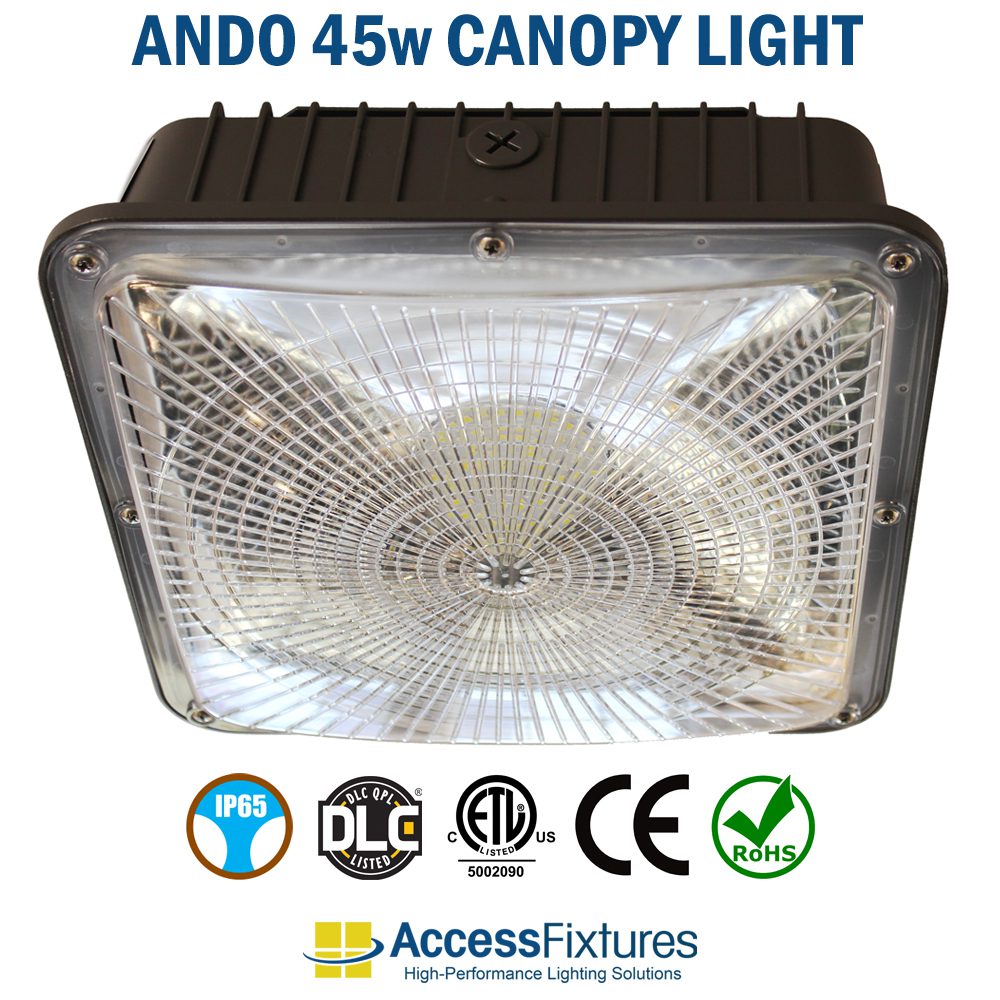
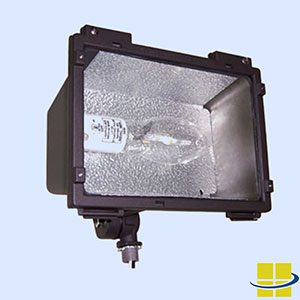
When selecting lighting fixtures, a major consideration should be the light bulb types or light source technology that will be best for you. Each kind of fixture has its own unique operating characteristics. These characteristics include efficacy, which can be measured in lumens per watt; color accuracy, which is measured in CRI; lamp (bulb) life, which is measured in hours; and lumen depreciation, which measures lumens lost over the lifetime of a fixture. Your decision will impact the quality of light, the maintenance requirements of the system, and the cost of operating the lighting fixtures.
In the vast majority of cases, LED light sources are much more efficient, cost-effective, and powerful than other traditional light sources. Read on to see why.
It should be noted that, statistically, the cost of energy to operate a lighting fixture is at least 90% of the total cost of the system. Before you make a decision on the type of light technology you deploy, it is important to know how many footcandles are required in the area you are lighting. Then, determine what light source can achieve your footcandle, CRI, Kelvin, and maintenance requirements while using the fewest watts.
Light Emitting Diodes (LEDs)
- Extremely efficient
- High life (50,000+ hours, sometimes as high as 400,000+ hours)
- Good color rendition and the ability to customize specific CRIs
- Dimmable: 0-10v dimming, step dimming, bi-level dimming
- Customizable beam angles, optics, color temperatures, nanometer ranges, and more
- Often the most affordable light source over time
LED technology has become so efficient, malleable, and affordable, it is now the go-to solution for almost every modern-day lighting project. Each new generation of LEDs has become better (in every way) than the the last. Today’s LEDs last 10+ times longer than compact fluorescents and far longer than typical incandescent bulbs. LEDs can be found in luminaires (light fixtures) and even retrofit lamps (bulbs).
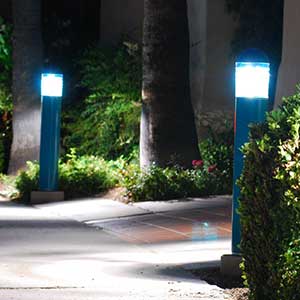
A light-emitting diode (LED) is a semiconductor diode that radiates light (electroluminescence) when current passes through it in the forward direction. Electrons move through a semiconductor and “fall into” other energy levels during their transit of the P-N junction. When these electrons transition to a lower energy level, they give off a photon of light. This photon may be in the infrared region or just about anywhere across the visible spectrum up to and into ultraviolet.
Because of the low power requirement for LEDs, using solar panels is sometimes more practical and less expensive than an electric line or generator. Unlike incandescent bulbs and CFLs, which send light in all directions, LEDs are considered directional, which means they aim their light in one direction. Of course, this “one direction” is extremely easy to manipulate, and adding more LEDs to a board or lamp makes omnidirectional light possible. LEDs waste none of their waste light (energy) on areas you don’t need illuminated; unlike HID or lamp-based technologies, they send almost no light back into the fixture housing. All light goes exactly where you need it.
Since LEDs do not have filaments, they are not damaged under circumstances when a regular incandescent bulb would be broken. Because they are solid (LEDs fall into the category of solid-state lighting), LED bulbs hold up well to jarring and bumping. These bulbs do not cause heat build-up; LEDs produce 3.4 or fewer BTUs/hour, compared to 85 for incandescent bulbs. They are unbelievably customizeable, too—Access Fixtures has LED fixtures in a wide range of Kelvin temperatures, CRI’s, distribution patterns, housing styles, etc. There is very little an LED cannot do. Lastly, no mercury is used in the manufacturing of LEDs, improving their value in all locations, especially in food-service applications or high-traffic areas.
Incandescent
- Inexpensive
- Good in cold climates
- Low efficiency
- Short life of 750 to 1,000 hours
- Often replaced by CFL
Incandescent lamps have commonly been used in residential lighting. A flow of electrical current heats a wire or filament to incandescence (the point at which light is emitted). The short life and low efficacy (measured as lumens per watt, or LPW) of this source limits its use to residential and decorative commercial lighting. The efficacy varies with wattage and filament type, but it generally ranges from 15 to 25 lumens per watt for general service lamps. An incandescent source produces light in a well-accepted, warm tone. It is more convenient because it can be run directly on line current and doesn’t require a ballast. Incandescent lights can be dimmed using relatively simple equipment and are available in different bulb sizes and shapes to add a decorative touch to an area.
To save energy, most fixtures that use incandescent bulbs are retrofitted with screw-in compact fluorescent bulbs or replaced with LED fixtures.
Linear Fluorescent, Plug-In Fluorescent, and Compact Fluorescent (CFL)
- Uses 65–75% less energy than incandescent
- Relatively inexpensive
- Lifetime of 10,000 to 20,000 hours
- Superior CRI
Customers with warehouses, light manufacturing facilities, and similar facilities are replacing old-style probe start metal halide and mercury vapor fixtures with linear fluorescent and LED high bay fixtures. These technologies use a fraction of the power of the old probe-start metal halides. Additionally, when fitted with a programmed-start ballast, the fixtures can have an occupancy sensor and the on/off feature will not reduce the operating life of the lamps. In virtually all cases, the switch reduces energy expenses by thousands of dollars a year and will eventually pay for cost of the fixtures.
Fluorescent lamps produce light by activating phosphors on the inner surface of the bulb via ultraviolet energy generated by a mercury arc. Because of the characteristics of a gaseous arc, a ballast is needed to start and operate a fluorescent lamp. The advantages of this kind of light include improved efficacy and longer life over incandescent lamps. Efficacy for fluorescent lamps ranges from 50 to 100 lumens per watt. Their low surface brightness and heat generation make them ideal for offices and schools where thermal and visual comfort is considered important.
The disadvantages of fluorescent lamps include: their large size relative to the amount of light produced, the difficulty of controlling their light, and their lack of outdoor effectiveness (their lumen output plummets in lower ambient temperatures).
Pulse Start Metal Halide (PSMH)
- High lumen output
- Operate reliably in wide range of temperatures
- Good color rendition (CRI)
- Long life of 20,000 hours
- Quicker to start up than old-style, probe-start fixtures
- Great in dirty environments
Metal halide lamps are similar in construction to older mercury vapor lamps but with other metallic elements in the arc tube. Light control of a metal halide lamp is more precise, since light emanates from the small arc tube. The major benefits of the pulse-start metal halide fixtures are that they can achieve up to 110 lumens per watt, have good color rendition, and last a long time. As of January 1, 2009, new lighting fixtures containing 150w to 500w metal halide lamps cannot be manufactured or imported unless their ballasts operate the lamp at a minimum efficiency level. These restrictions have essentially forced probe-start fixtures out of the market. Read more about pulse-start metal halide vs. probe-start metal halide.
Metal halide is still a viable option for outdoor lighting projects, even in an LED-dominated market. In most instances, metal halide is still a more affordable option, albeit less efficient than LED. Sports lighting is the most popular application for metal halide fixtures; this is especially the case for residential tennis and basketball courts that are only used a few hours a week. Metal halide offers strong color rendering and a respectable rated life.
Metal halide has been used in commercial locations for years and is more efficient than it has ever been. While the argument for LED becomes more compelling every day, some commercial locations may still prefer metal halide fixtures. If you’d like help weighing the pros and cons of metal halide and LED, contact an Access Fixtures lighting specialist at 800-468-9925. We’ll be glad to discuss your specific project and help you find the right solution.
Some metal halide lamps may suffer non-passive failure, which means in some instances they can explode and send molten glass down to the ground. All metal halide lamps should be used in enclosed luminaires or with open-rated sockets. Open-rated sockets are pink and will only accept protected metal halide lamps, which do not suffer non-passive failure. Enclosed fixtures or open-rated sockets will provide safe working environments. Please note that insurance companies and/or local regulations may require the use of enclosures or open-rated sockets. (Note: All Access Fixtures metal halide luminaires come standard with open-rated sockets.)
Induction
- Long mean lifetime of 100,000 hours
- Virtually no maintenance required
- Excellent color rendering (CRI)
- Great performance in any climate
Induction lighting is a similar to the fluorescent technology. Induction lamps do not use electrodes and are driven by high-frequency currents between 250 kHz and 2.65 MHz via an external generator. They are available in limited wattages and are known for their exceptionally long lifetimes. Lamp efficacies typically range from 64 to 88 lumens per watt (compare to LEDs, which operate at 105+ lumens/watt.
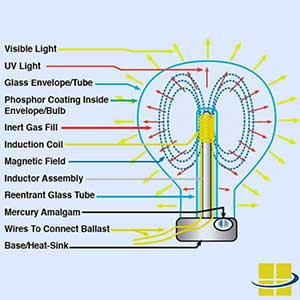
Induction lighting is virtually maintenance-free because of its 100,000-hour rated life. If an induction fixture is used 24 hours a day, every day of the year, it will offer about 11 years of reliable light. This makes induction extremely useful in applications where lamp replacement is very expensive, such as hard-to-reach places like high-mounted wall packs, limited-access areas like airports and tunnels, parking lot lighting where a lift is required for service, and elsewhere. Induction lighting is also used where safety is paramount and the light have to stay on, such as parking garages, walkways, around ATMs, and in prisons.
Extreme temperatures have minimal effect on induction lighting, making it a great choice for most climates. The light generated from an induction lamp is crisp and white, with 80+ CRI, high reliability, and instant on/off. Induction fixtures can typically provide as much, if not more light than a fixture at more than twice the energy consumption with better quality light. The advantages of the induction can turn into major dollar savings when considering energy savings, maintenance, labor, and replacement lamp cost of existing lighting fixtures. In many cases, the payback in maintenance savings will more than offset the initial cost of the system.
U.S. Department of Energy: Information on Induction Lighting
High-Pressure Sodium (HPS)
- High lumen output
- Decent life of 24,000 hours
- Low color rendition (CRI)
- Operates reliably in wide range of climates
- Low Kelvin puts out yellow-orange glow
In the 1970s, increasing energy costs forced us to put new attention on the efficiency of our lighting fixtures. Enter HPS lamps, which were actually developed in the 1960s. With efficacies ranging from 80 to 140 lumens per watt, these lamps provide about seven times as much light per watt as incandescent and about twice as much as some mercury or fluorescent. An HPS lamp also has a good rated life of 24,000+ hrs. It is a very reliable efficient source of light and for years was the de facto standard for street lighting and elsewhere.
Before LEDs, the major objection to HPS was its yellowish color and low color rendition. In fact, the yellowish color is both an objection and feature. HPS is ideal for outdoor applications such as street lights, wall packs and bollards, because it is long-lasting and efficient. The warmer light also has less of an impact on the environment in the same way as whiter light does. Now, wildlife-friendly LEDs are even more effective, but HPS had previously been the best solution available. Many cities, some states, and even countries required HPS-colored light to lessen the impact on the environment.
Speak to an Access Fixtures Lighting Specialist about Choosing the Right Fixture
Unsure of what lamp type will be suit your project? We will be glad to answer your questions. We want you to walk away with the right fixture for your needs, your budget, and your goals. We are passionate about lighting and love what we do—we’ll get you an answer. To speak with an Access Fixtures lighting specialist, call (800) 468-9925.