
Bollard Lighting Safety Considerations for Safer Sites
Outdoor spaces need illumination that helps people see where they are going without creating new obstacles, glare, dark gaps, or maintenance problems. For commercial properties, campuses, hospitality sites, parking areas, and public-facing facilities, the right low-level fixtures can define pedestrian routes while supporting visibility around entrances, curbs, ramps, and other changes in the walking environment.
Effective bollard lighting safety considerations begin with the site itself. Fixture location, light distribution, mounting height, surrounding traffic, electrical requirements, weather exposure, and maintenance access all influence the finished result. Access Fixtures supplies commercial LED lighting solutions and offers production and built-to-order options for a wide range of applications. Its lighting specialists and engineers can also work with project teams to develop solutions around specific site requirements.
Start With the Site and Intended Use
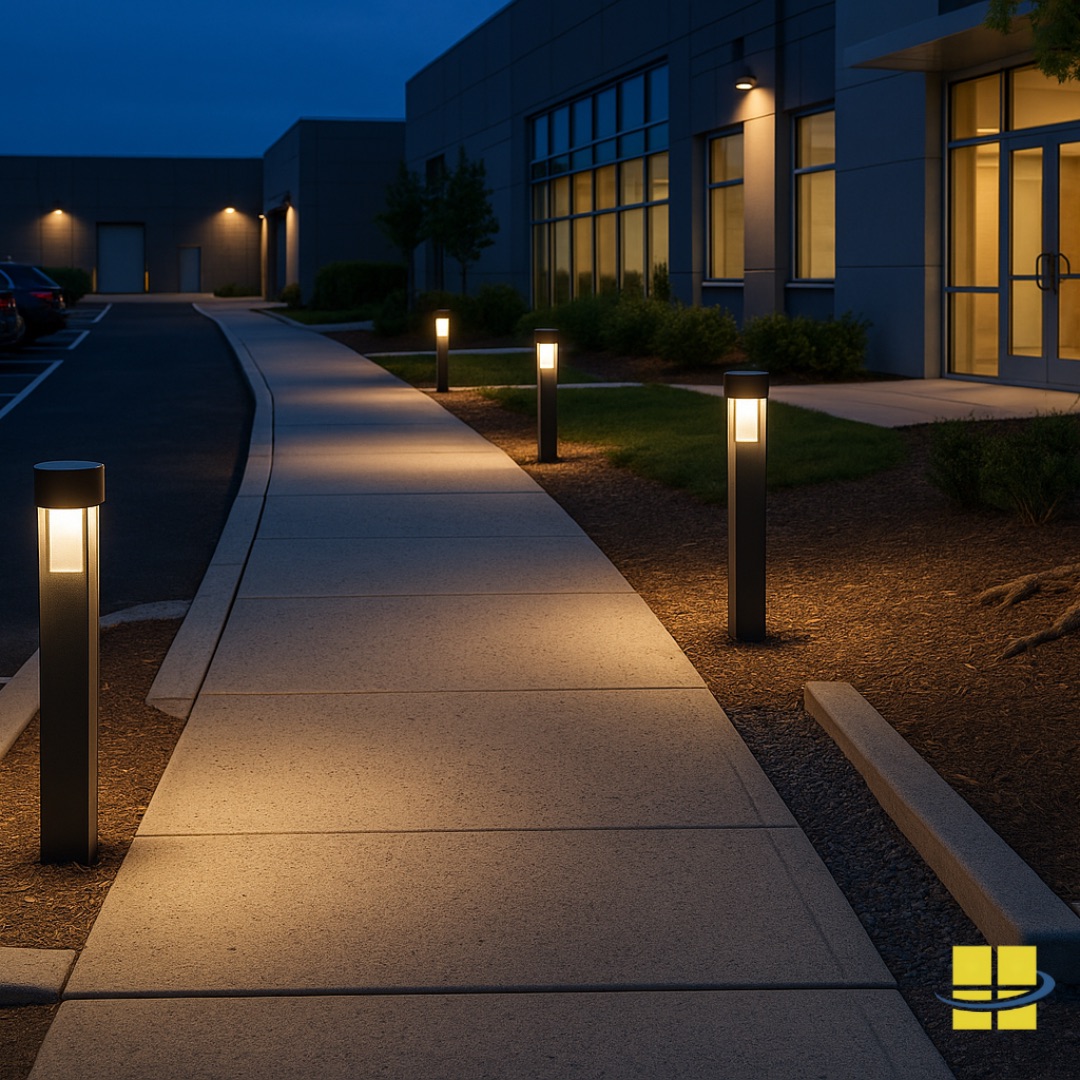
Selecting a fixture before evaluating the property can lead to poor placement, inadequate coverage, or unnecessary light in areas where it is not needed. Begin by identifying how the outdoor area functions after dark. Walk the property and note:
- Primary pedestrian routes
- Entrances and exits
- Parking-to-building connections
- Curbs, ramps, stairs, and elevation changes
- Vehicle lanes and loading areas
- Landscaping and irrigation
- Utility locations
- Service and maintenance routes
- Emergency access points
A risk assessment also helps determine whether a low-level fixture is appropriate for each location. Some areas may require another luminaire type, while pathways and transition areas may be well suited to bollards.
Plan Bollards Around Pedestrian Access
Low-mounted fixtures can help people visually follow a route from parking areas to doors, courtyards, transit stops, and other destinations. Placement should make that route easier to understand without narrowing it. Keep units away from the usable width of walkways and accessible routes. Consider wheelchairs, strollers, carts, deliveries, landscaping equipment, and snow-removal equipment where applicable.
Near a curb, ramp, or step, locate fixtures where they illuminate the change in elevation without becoming another object people must maneuver around. Consistent positioning is generally easier for pedestrians to interpret than an irregular arrangement. The objective is a readable route with useful illumination along the walking surface, particularly where direction or elevation changes.
Coordinate Outdoor Lighting With Vehicle Movement
Parking lots and driveways create different demands because drivers and pedestrians occupy the same environment. Fixtures along parking edges can help identify the transition between vehicle space and pedestrian space. They may also make people walking between parked vehicles and entrances easier to see.
Placement still requires care. A fixture positioned directly in a bumper overhang area or turning path can face repeated impacts. Delivery vehicles and maintenance equipment introduce additional clearance requirements. Where physical vehicle protection is required, do not assume a standard light fixture is designed to function as an impact-rated barrier. Depending on the application, a separate protective barrier or a product intended for demanding conditions may be appropriate.
Access Fixtures offers commercial LED bollards in multiple configurations, including round, square, aluminum, and stainless steel options. The company also offers different reflector and optical configurations, allowing fixture selection to respond to the site rather than forcing one fixture style into every application.
Keep Emergency and Service Routes Clear
Emergency access should be reviewed before fixture locations are finalized. Fire lanes, hydrants, gates, service drives, loading areas, and building approaches need sufficient clearance for responders and facility operations. A row of fixtures that looks orderly on a drawing can still cause problems if it interferes with turning paths, gate operation, equipment access, or required clearances.
Utility and irrigation plans should also be coordinated before excavation. Doing so can reduce conflicts during installation and help establish sensible locations for underground conduit, foundations, drainage, and landscape features. Planning these conditions early is generally simpler than relocating fixtures after foundations or electrical infrastructure have been installed.
Choose Mounting Height for the Lighting Task
Mounting height affects how light reaches the surrounding ground, how far it spreads, and how closely fixtures may need to be positioned. Low-level illumination works well where the design needs to define walkways and landscape areas without using tall poles. Access Fixtures notes that bollard lights can also be useful in parking applications where mounting heights above eight feet are restricted by ordinance or site conditions.
Height should not be selected independently from output and optics. A lower unit with a narrow distribution may require closer spacing. Another fixture may produce wider coverage from a different height. The appropriate choice depends on the property, photometric performance, fixture construction, and intended visual effect.
Use Luminaire Spacing to Limit Dark Gaps and Hot Spots
There is no single spacing distance that works for every project. Luminaire spacing should be based on fixture output, optic, mounting height, site geometry, surrounding ambient illumination, and the required illuminance level. Place units too far apart and dark areas may develop between them. Place them too closely, and the design can create unnecessary brightness or visible hot spots near each fixture.
| Site Condition | Lighting Priority | Placement Concern |
|---|---|---|
| Pedestrian walkway | Consistent visibility along the route | Dark gaps or obstacles |
| Entrance approach | Clear route toward doors | Uneven illumination |
| Ramp, curb, or step | Make elevation changes visible | Restricted access |
| Parking edge | Define pedestrian boundaries | Vehicle contact |
| Courtyard or gathering space | Comfortable, readable movement | Glare and excessive brightness |
A photometric study can test these relationships before products are ordered.
Control Glare and Unshielded Light
Higher output is not automatically better. An unshielded light source or poorly controlled optic can send illumination toward a driver's eyes, nearby buildings, windows, roadways, or neighboring property. It can also contribute to light pollution. Optics should direct useful light toward the intended task area. Shielding may also be appropriate where illumination needs to be limited on one side. The result should be comfortable visual guidance rather than a series of intensely bright points surrounded by darkness.
Select Fixtures for Outdoor Exposure
Outdoor luminaires face rain, dirt, temperature changes, landscaping activity, and other environmental conditions, so construction matters. Material selection should match the environment in which the fixture will operate. Properties in demanding locations may need additional attention to corrosion exposure, impact risk, moisture, snow, landscape debris, or cleaning practices. Choosing a fixture for those conditions can reduce premature deterioration and simplify ongoing care.
Consider LED Bollard Options for Commercial Properties
An LED bollard can provide low-level exterior illumination with several available light-source and optical configurations. Access Fixtures offers models using screw-in LED lamps as well as integrated LED drivers and modules. Its product range includes round dome-top, round flat-top, and square forms, giving architects, contractors, property managers, and facility teams options for matching both performance and architectural requirements.
Applications can include:
- Pedestrian paths
- Building approaches
- Landscape areas
- Driveways
- Parking environments
- Hospitality properties
- Educational facilities
- Housing complexes
- Commercial grounds
Fixture selection should begin with the performance required for the property. Appearance can then be evaluated alongside output, distribution, construction, finish, and maintenance requirements.
Evaluate Solar Bollards Where Wiring Is Impractical
Solar fixtures may be useful where trenching or access to utility power presents difficulties. Their performance, however, depends on the amount of usable sunlight available to the photovoltaic panel. Trees, buildings, seasonal shading, panel orientation, battery capacity, and regional weather conditions all influence performance. For that reason, solar placement requires its own site review rather than simply substituting a solar product for a hardwired unit.
Access Fixtures also offers the SECU, a solar-powered product designed to convert certain new or existing six-inch outside-diameter security bollards into illuminated posts. For locations where that configuration is appropriate, it can provide another approach to combining perimeter visibility with an existing security-bollard layout. See our bollard lighting layout ideas guide for more on coordinating solar solutions within a site plan.
Plan Electrical Installation Before Ordering
Hardwired exterior lighting requires electrical planning alongside fixture selection. Confirm circuit requirements, fixture locations, foundation conditions, controls, conduit routing, and access to serviceable components before installation begins. A qualified electrician should ensure that all electrical components are handled according to applicable codes and the requirements of the particular installation.
Depending on the project, that may involve branch circuits, grounding, bonding, junction boxes, conduit, conductor sizing, moisture-resistant connections, and electrical protection. Access Fixtures supplies the luminaires and lighting expertise. Electrical installation should be performed by appropriately qualified professionals responsible for the project.
Secure Bollard Fixtures to Stable Ground
Even correctly specified lighting can become a problem if the mounting system is unstable. Foundations and anchor systems need to suit the fixture, surface, soil conditions, wind exposure, and expected activity around the installation. Bases should be level and firmly secured so the fixture remains aligned and the intended distribution is maintained.
Areas close to vehicles deserve additional review. Physical impact exposure should be addressed through location, protection, or an appropriately designed barrier rather than relying on the luminaire housing to stop a vehicle. Stable mounting also helps prevent water intrusion, movement around electrical connections, and gradual misalignment.
Maintain Lighting Performance Over Time
Outdoor systems need periodic inspection after installation. Dirt on lenses can reduce usable output. Loose hardware, damaged seals, corrosion, vegetation, water intrusion, or failed electrical components can gradually change performance. A practical maintenance routine may include cleaning lenses and solar panels, clearing debris from fixture bases, checking housings and fasteners, inspecting seals, watching for flicker, and keeping vegetation from blocking the intended distribution.
Snow should also be considered in colder locations. Access Fixtures notes that accumulation can reduce the useful output of low-mounted fixtures, making placement an important consideration in northern climates. Maintenance planning is easier when access panels, drivers, connections, and surrounding ground remain reachable after landscaping and other site work are complete.
Use Photometric Planning Before Purchasing Fixtures
Visual estimates alone do not show exactly how a proposed system will perform. A photometric study models illumination across a defined property using selected luminaires, mounting locations, heights, optics, and output. The resulting calculations can help identify insufficient areas, excessive brightness, uniformity problems, or fixture layouts that should be adjusted before equipment is ordered.
For properties with parking lots, walkways, loading areas, entrances, or unusual geometry, that information can reduce guesswork. Access Fixtures offers photometric studies and describes them as a way to simulate a design against project specifications before purchasing fixtures. This process can also help project teams evaluate spacing, fixture quantity, optics, wattage, and placement together instead of treating each decision separately.
Why Choose Access Fixtures for Bollard Lighting?
Access Fixtures focuses on high-performance commercial, industrial, sports, hospitality, and technical lighting applications. The company offers both production and built-to-order solutions, with lighting specialists and engineers available to help develop project-specific configurations. Its bollard portfolio includes multiple shapes, materials, heights, optical approaches, finishes, and LED configurations. This gives project teams room to select products around architectural requirements, pedestrian use, environmental exposure, and photometric performance rather than relying on a single standard fixture.
Access Fixtures has also supplied bollard lighting for commercial applications such as Orlando International Airport, illustrating the type of large-property environment in which its products are used. For projects requiring a less standard configuration, built-to-order capabilities can help address site-specific requirements.
Get Help Selecting Bollard Lighting for Your Site
Safer exterior illumination begins with understanding where people walk, where vehicles move, how much light the area requires, and what environmental conditions the fixtures will face. Review your project requirements with an Access Fixtures lighting specialist or request a quote or photometric study to identify a solution suited to your property.
800-468-9925