
Staying ahead of the October 1, 2026, compliance deadline requires more than just choosing any LED fixture. Under Maine’s "An Act to Promote Responsible Outdoor Lighting" (H.P. 1295 / LD 1934), public and commercial improvement projects must now utilize luminaires specifically engineered to meet strict 3000K CCT limits and full-shielding mandates.
Access Fixtures offers several product families that are already Maine dark sky compliant and ready for your next municipal or commercial project.
Key Takeaways
-
- The 3000K Color Limit: Starting October 1, 2026, almost all new or replacement public outdoor lighting in Maine must be 3000 Kelvins or lower. This "warm white" requirement is designed to reduce blue-light scatter and protect Maine's natural night sky and wildlife
- Mandatory Full Shielding: Any luminaire emitting over 1,000 lumens must be "fully shielded," meaning it emits zero light at or above the horizontal plane. Additionally, fixtures must restrict high-angle light to less than 5% of their total output to eliminate glare and light trespass
- Strict Illumination Caps: Projects must now adhere strictly to ANSI/IES standards (such as RP-8 for roads and parking). Lighting levels are legally capped at 125% of these recommendations to prevent over-lighting, which Maine now classifies as a form of light pollution.
High-Performance 3000K LED Bollard Lights (Maine-Ready)
Our bollard lights are designed to illuminate pedestrian pathways without contributing to skyglow.
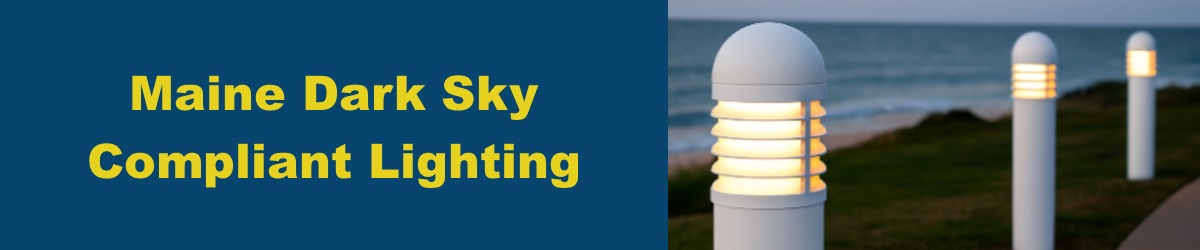
- Cone Reflector Technology: Many of our bollard models utilize specialized internal cone reflectors that direct 100% of light downward, ensuring they function as fully shielded luminaires.
- Warm CCT Options: We offer a wide range of bollards available in 3000K or lower to meet the new state limit while maintaining high visibility for safety.
- Vandal-Resistant & Marine-Grade: Built for Maine’s rugged winters, these fixtures feature durable finishes and high-impact resistance for public spaces.
Shop ARCI LED Bollard Lights That Meet Dark Sky Compliance -->

Full Cutoff LED Wall Packs & Ceiling Fixtures
For building perimeters and entryways, precision optics are essential to avoid light trespass into protected natural areas (limited to 0.1 lux under the new law).
- Full Cutoff Wall Packs: Our commercial-grade wall packs are available in full cutoff configurations, meaning they emit zero light above the 90-degree horizontal plane.
- Bi-Directional & Downlight Sconces: The Access Fixtures Up/Down LED wall packs include bi-directional sconces that provide high-CRI illumination at 3000K, perfect for retail facades and modern office spaces.
- The OCTA Dark Sky Series: For specialized architectural needs, the OCTA series offers Dark Sky-approved ceiling mounts that deliver warm white light (3000K) directly where it is needed.
Shop CUDL Full Cutoff LED Wall Packs That Meet Dark Sky Compliance -->
Area & Parking Lot Lighting: ANSI/IES RP-8 Compliance
Maine H.P. 1295 mandates that light levels cannot exceed 125% of the recommended ANSI/IES standards.
- ANSI/IES RP-8 Compliant Fixtures: Our area lights are designed to meet RP-8 standards for roadways and parking facilities, ensuring your project doesn't suffer from "over-lighting" citations.
- Custom Photometric Design: We provide detailed photometric reports for your site to ensure that your area lights provide the exact amount of illumination required, no more, no less.
- Lumen Management: For fixtures emitting more than 1,000 lumens, our area lights feature precision shielding to stay below the 5% limit for high-angle light emission.
Shop APTA Area Lights / Flood Lights / Parking Lot Lights That Meet Dark Sky Compliance -->
Future-Proof Your Maine Projects
Don’t wait for the 2026 deadline to update your project specifications. Ensure your facility is future-proof and compliant with Maine’s new dark-sky standards today.
- Access Fixtures’ Maine HP 1295 Compliance Checklist for Outdoor Lighting
- What the New “Responsible Outdoor Lighting” Act Means for Your Facility
- Browse our Maine-Compliant 3000K Catalog
- Request a Compliant Lighting Layout
- Contact an Access Fixtures Lighting Specialist: (800) 468-9925
Conclusion
Adhering to Maine’s "An Act to Promote Responsible Outdoor Lighting" (H.P. 1295) is more than a legal hurdle—it is an opportunity to enhance the efficiency and safety of your facility while preserving the state’s natural heritage. By prioritizing Maine dark sky compliant lighting today, you avoid the risk of non-compliant replacements after the October 2026 deadline and benefit from the long-term energy savings of high-performance LED technology.
At Access Fixtures, we combine technical expertise with a specialized inventory of 3000K, fully shielded luminaires to ensure your project meets every requirement of the new law. From municipal streetscapes to commercial building perimeters, our engineering team is ready to help you navigate the complexities of H.P. 1295.
Maine Dark Sky Compliant Lighting Frequently Asked Questions (FAQs)
Does the law require me to replace my existing lights immediately?
No. The law applies to public outdoor lighting that is installed or replaced after October 1, 2026. Existing fixtures can remain in place until they reach the end of their functional life.
What happens if I install a fixture higher than 3000K?
After the deadline, installing a fixture above 3000K for public improvements (unless exempt, like sports lighting) will be a violation of state law. This could result in mandatory replacements or administrative penalties, which vary by municipality but can be costly.
Are there any exceptions for safety or emergency lighting?
Yes. Exemptions exist for emergency services, law enforcement, and temporary road construction lighting. Additionally, certain Department of Transportation (DOT) roadway and pedestrian lighting projects may exceed the 3000K limit where necessary for public safety.
How do I prove my lighting meets the 125% ANSI/IES limit?
The most reliable method is through a photometric study. Access Fixtures provides these reports to calculate exactly how much light will hit the ground, ensuring you stay within the legal limits of RP-8 (roadways) or RP-7 (industrial) standards.
What is "nonessential lighting," and when must it be turned off?
Nonessential lighting includes landscape, facade, and decorative lighting. Under H.P. 1295, these must be extinguished during nighttime hours, typically between 10:00 p.m. and sunrise, or one hour after a business closes.