
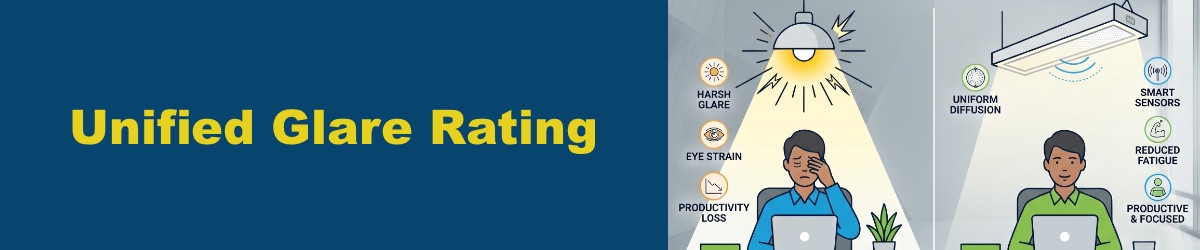
Unified Glare Rating and Adaptive Glare Control: The New Standard in Lighting
The lighting industry has undergone a fundamental shift. For decades, performance was measured in lumens per watt. Today, the most forward-thinking facility managers are asking a different question: how does the light make workers feel? If you have not heard about Unified Glare Rating, you may want to know what it is and why it matters.
Unified Glare Rating (UGR) is the internationally adopted metric that answers that question. It quantifies visual discomfort from a lighting installation, and as new regulatory frameworks take effect in 2027, it is fast becoming a compliance requirement, not just a design consideration.
This guide explains what Unified Glare Rating means, why it matters for your facility's productivity and legal standing, and how Access Fixtures' adaptive glare control technology delivers compliant, comfortable light over a 100,000-hour lifespan, lowering your Total Cost of Ownership (TCO) in the process.
Is your facility ready for the 2027 glare compliance deadline?
Get a Photometric Analysis or speak to an Access Fixtures Lighting Specialist at 800-468-9925.
Key Takeaways
-
- UGR is a compliance deadline, not just a design preference: The 2027 EU glare mandates are coming. Facilities still running standard LEDs above UGR 22 face forced retrofits and potential regulatory exposure. Specifying UGR <19 fixtures now is the lower-cost, lower-risk path, and Access Fixtures' Low-Glare light fixtures are already fully compliant.
- Glare control directly impacts your bottom line: High-UGR environments drive measurable increases in worker eye fatigue, headaches, and reduced concentration. Lowering glare isn't a comfort upgrade; it's a productivity investment. Pair that with a 100,000-hour rated lifespan and advanced thermal management, and the TCO case makes itself.
- UGR is room-specific, a spec sheet isn't enough: The same fixture produces different UGR values in different spaces. Room dimensions, surface reflectances, mounting height, and observer position all feed into the calculation. Any facility serious about compliance needs a site-specific UGR calculation, not just a product data sheet.
What Is Unified Glare Rating (UGR)?
Unified Glare Rating is a standardized measure of the subjective glare experienced by a person in an indoor lit environment. It was developed by the International Commission on Illumination (CIE) and is now the primary glare metric referenced in EN 12464-1, the European standard for indoor workplace lighting, as well as the WELL Building Standard v2 used globally.
A critical point often misunderstood: UGR is not a property of a single luminaire. It is a calculated value derived from the CIE formula, which accounts for:
- The luminance of each luminaire in the field of view
- The solid angle subtended by each luminaire at the observer's eye
- The background luminance of the room
- The position index (the observer's viewing angle relative to each fixture)
This means two identical fixtures installed differently at different heights, spacings, or in rooms with different reflectance values will produce different UGR results. This is why a professional, site-specific UGR calculation is essential before any installation.
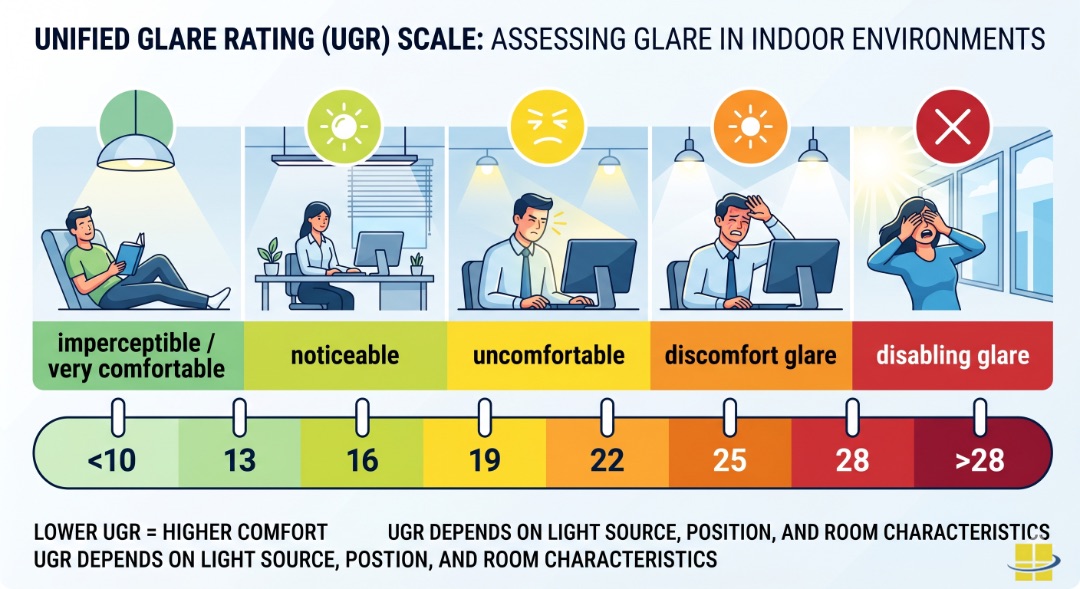
UGR Values: What the Numbers Mean
| UGR Value | Comfort Level | Typical Application |
|---|---|---|
| < 10 | Imperceptible glare | Art galleries, surgical suites |
| 13 | Just perceptible | High-precision laboratories |
| 16 | Perceptible but acceptable | CAD workstations, fine assembly |
| 19 | Compliance threshold | Offices, classrooms, most workplaces |
| 22 | Noticeable discomfort | Warehouses (task-dependent) |
| 25 | Significant discomfort | General industrial (limited dwell time) |
| > 28 | Intolerable | Non-compliant for most occupied spaces |
The UGR 19 threshold is the benchmark most frequently cited in workplace lighting standards globally. Facilities targeting WELL certification or EU compliance after 2027 should design to this value or below.
Why Unified Glare Rating Matters for Your Facility
Worker Productivity and Eye Strain
Lighting research published through the Lighting Research Center has consistently linked high-glare environments (UGR above 22) to elevated rates of headache, eye fatigue, and reduced concentration. In office environments, a reduction in glare from UGR 28 to UGR 19 has been associated with measurable improvements in sustained attention tasks.
For industrial settings, the stakes are even higher. "Disability glare" - where intense glare sources partially obscure the visual field, can render hazards invisible, contributing directly to workplace accidents. OSHA guidance on industrial lighting implicitly addresses luminance ratios that correlate with high UGR environments.
Regulatory Compliance - The 2027 Mandate
Updates to the EU's Energy-related Products (ErP) Directive, alongside amendments to EN 12464-1 currently in final review, are expected to establish mandatory maximum glare thresholds for luminaires sold into commercial and public space applications, with enforcement timelines beginning Q1 2027.
Facilities that have already installed non-compliant fixtures will face retrofit requirements during their next scheduled refurbishment cycle. Those who act now, specifying low-UGR fixtures during a current project, avoid the cost and disruption of forced replacement.
Total Cost of Ownership (TCO)
Low-glare fixtures are not simply a regulatory compliance cost; they are an investment with a measurable return. Reduced absenteeism, lower maintenance frequency from advanced thermal management, and extended relamping cycles all contribute to a lower TCO over the life of the installation.
Access Fixtures' low-glare LED light fixtures are engineered with thermal-resistant phosphor coatings that maintain lumen output and color consistency across a rated 100,000-hour lifespan, roughly 11 years of continuous 24/7 operation.
The Rise of Adaptive Glare Control
Traditional luminaires are static. They deliver a fixed light distribution regardless of occupancy, time of day, or the presence of natural light. Adaptive Glare Control is the next generation of intelligent lighting architecture that treats glare as a dynamic variable to be managed in real time.
Access Fixtures' Adaptive Glare Control systems integrate three core technologies:
Smart occupancy and daylight sensors monitor ambient light levels and occupancy in real time. As natural light enters through windows or skylights, the system dims or redirects artificial light to maintain a consistent, low-UGR environment without over-illuminating, reducing energy consumption simultaneously.
Task-optimized beam shaping concentrates light precisely where work is occurring while softening peripheral "stray" light that contributes to disability glare. The result is better contrast at the task plane with reduced luminance in the field of view, the two primary levers for UGR reduction.
Advanced diffusion optics with phosphor coating replace the hard acrylic diffusers found in standard industrial luminaires with engineered optical elements that distribute luminous flux evenly across the emitting surface. Combined with thermal-resistant phosphor coatings, these optics maintain their UGR performance for the full 100,000-hour rated lifespan without the lumen depreciation that causes standard fixtures to "age into" non-compliance.
Speak to an Access Fixtures Lighting Specialist about Choosing the Correct Low-Glare Light Fixtures for Your Project
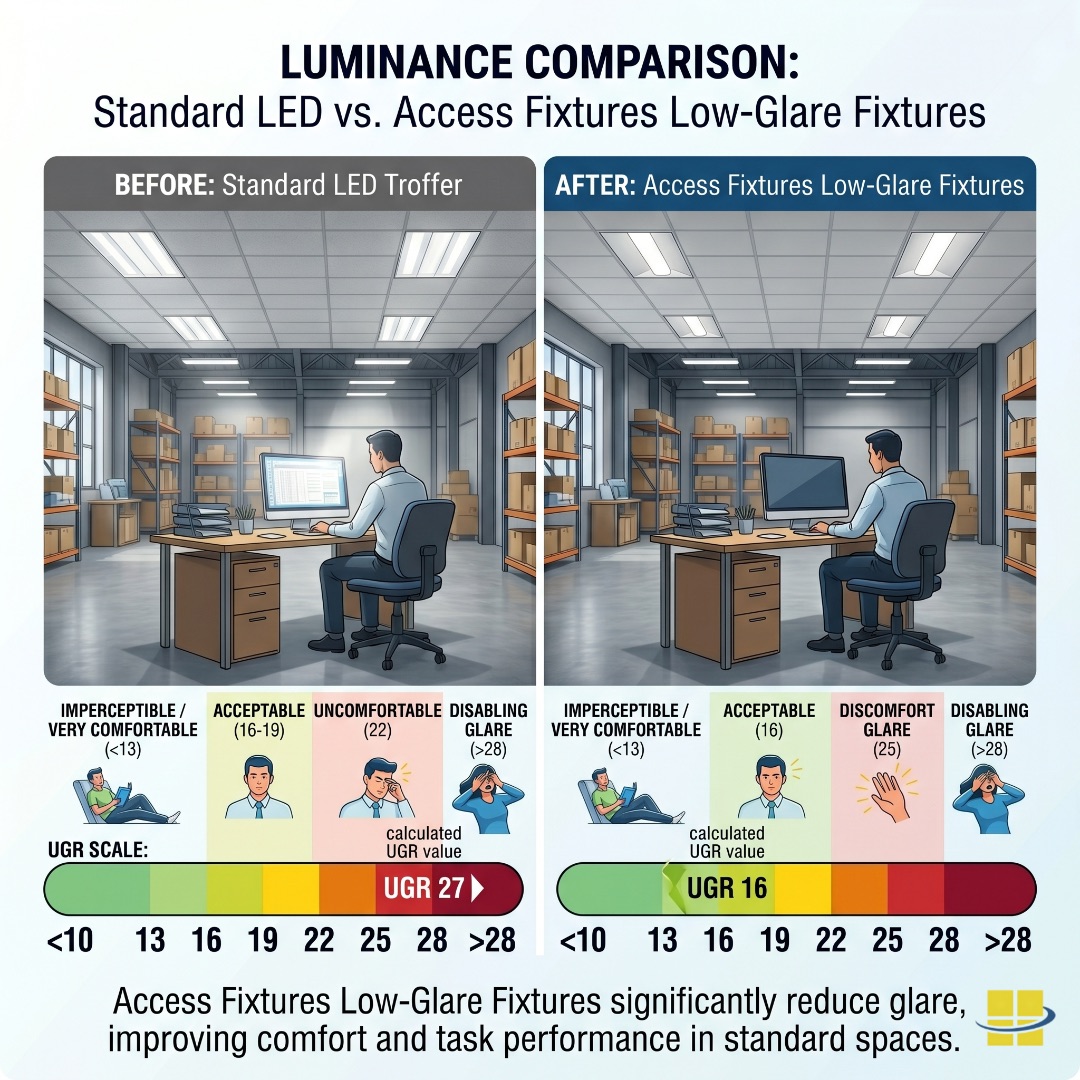
Standard LED vs. Access Fixtures Low-Glare Light Fixtures - A Comparison
| Feature | Standard LED | Access Fixtures Low-Glare Lights |
|---|---|---|
| Glare rating | UGR 22–28 (typical) | UGR <19, verified per CIE method |
| Visual comfort | High contrast, potential hot spots | Uniform diffusion across the fixture surface |
| 2027 regulatory status | May require retrofit or replacement | Fully compliant with anticipated directives |
| Worker productivity impact | Linked to higher rates of eye fatigue | Optimized for sustained concentration |
| Thermal management | Standard heat-sink design | Advanced phosphor coating, maintained output |
| Rated lifespan | 50,000-75,000 hrs (typical) | 100,000+ hrs |
| Maintenance cycle | Standard replacement schedule | Extended - lower lifecycle cost |
| Smart control integration | Limited or unavailable | Native sensor and BMS integration |
How to Calculate UGR for Your Facility
Because Unified Glare Rating is a room-specific calculation, generic spec sheets cannot tell you whether a given fixture will achieve UGR <19 in your space. The calculation requires:
- Room dimensions (length, width, ceiling height)
- Room surface reflectances (ceiling, walls, floor)
- Fixture type, luminous intensity distribution, and mounting height
- Assumed observer position and viewing direction
Access Fixtures provides complimentary UGR calculations for qualified projects using AGi32 photometric software, the industry standard for CIE-compliant lighting analysis. Our results are delivered as a full photometric report suitable for WELL certification submissions or regulatory documentation.
How to Future-Proof Your Facility with Low-Glare Lighting
Whether you are managing a new construction project, a scheduled refurbishment, or a proactive upgrade ahead of the 2027 compliance window, the transition to low-glare systems follows a clear framework.
Step 1 - Audit your current installation. Identify fixtures with UGR values above 22, prioritizing spaces with prolonged human occupancy (offices, control rooms, manufacturing lines, educational facilities).
Step 2 - Request a site-specific UGR calculation. Off-the-shelf replacement is not always straightforward; room geometry and mounting conditions must be accounted for. A professional calculation ensures your replacement specification will actually achieve the target UGR.
Step 3 - Specify compliant fixtures with long-term thermal integrity. Avoid fixtures that achieve low UGR only at initial installation. Thermal degradation of standard diffusers and phosphors causes UGR to rise over time. Access Fixtures' thermal-resistant optics maintain their photometric performance across the rated lifespan.
Step 4 - Integrate smart controls. Adaptive sensors allow your installation to respond dynamically to occupancy and daylight, reducing energy costs while continuously maintaining low-UGR conditions as ambient light changes throughout the day.
Frequently Asked Questions About Unified Glare Rating
Q: What is a good UGR value for an office or workspace?
A: For most office and commercial environments, a UGR of 19 or below is the accepted target, as recommended by EN 12464-1. This threshold is associated with comfortable, fatigue-free working conditions for tasks requiring sustained visual attention. Spaces with highly precise visual tasks, such as CAD drafting or laboratory work, may target UGR 16 or lower.
Q: Is UGR a property of the luminaire or the room?
A: UGR is a property of the complete installation, not the fixture alone. The same luminaire can produce different UGR values depending on room dimensions, surface reflectances, mounting height, and the observer's position. This is why a site-specific calculation using actual room parameters is required for accurate compliance assessment.
Q: How is UGR calculated?
A: UGR is calculated using the CIE (International Commission on Illumination) formula, which factors in the luminance of each fixture in the field of view, the solid angle each fixture subtends at the observer's eye, background luminance, and a position index. Software such as AGi32 or Dialux performs this calculation using photometric data from the manufacturer.
Q: What does UGR <19 mean on a product spec sheet?
A: When a manufacturer states "UGR <19," they are typically publishing a tabulated UGR value calculated under a specific set of standard room conditions (often a 4H × 8H room with standard reflectances). This is a useful comparison metric, but it does not guarantee UGR <19 in every installation. Always request a room-specific calculation for compliance-critical projects.
Q: Will UGR compliance be legally required in 2027?
A: Anticipated updates to EU ErP Directive regulations and the EN 12464-1 standard are expected to establish mandatory UGR thresholds for commercial and public-space luminaires beginning in 2027. While the final regulatory text is still in development, proactive compliance now protects against retrofit costs and project delays later. We recommend consulting the latest CEN and EU Commission publications for the current status.
Q: How does adaptive glare control reduce UGR?
A: Adaptive Glare Control systems reduce UGR through two mechanisms: (1) dynamic dimming, which reduces fixture luminance as ambient daylight increases, a key variable in the UGR formula; and (2) task-optimized beam shaping, which concentrates luminous flux at the task plane rather than allowing stray light to enter the peripheral field of view. Both effects lower the calculated UGR in real-world conditions.
Q: How long do low-glare LEDs maintain their UGR performance?
A: Standard LED diffusers and phosphors degrade over time, causing lumen depreciation and altered light distribution that can raise UGR values as the fixture ages. Access Fixtures' thermal-resistant phosphor coatings are rated to maintain their photometric output and distribution characteristics across a 100,000-hour lifespan, ensuring that the UGR performance specified at installation is preserved for the life of the product.
Q: Can Access Fixtures provide a UGR calculation for my project?
A: Yes. Access Fixtures provides complimentary site-specific UGR calculations for qualified commercial and industrial projects, performed using AGi32 photometric software. Contact our team at 800-468-9925 or use the request form above to get started.