
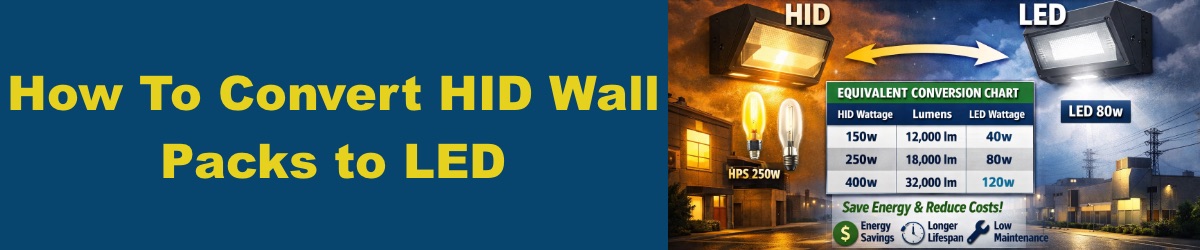
 Determining the best LED equivalent wall packs for your outdated HID units can be complicated. Using a conversion chart can simplify the process by providing a clear comparison of lumens to traditional wattage values. Whether switching from high-pressure sodium (HPS) or metal halide (MH), there are a hundred questions to ask about wattage, delivered light, photopic and scotopic lumens, and more. To help, we have broken down and cataloged our methodology for making the right selection. If you have any questions along the way, feel free to contact us for clarification. If you’d simply rather not deal with all these calculations yourself, give us a call, and we’ll take care of them for you. This article will also address common questions about the LED equivalent chart and conversions to help guide your decision-making process.
What Are The Benefits of LED Conversion?
Converting to LED lighting offers numerous benefits, including significant energy savings due to reduced energy use, longer lifespan, and reduced maintenance costs. LED bulbs use up to 90% less energy than traditional incandescent bulbs, making them an attractive option for those looking to reduce their energy consumption and overall energy use. Additionally, LEDs can last up to 50,000 plus hours or more, compared to the 1,000-2,000-hour lifespan of incandescent bulbs. This means that LED bulbs need to be replaced less often, resulting in lower maintenance costs and reduced waste. While the initial cost of LED bulbs may be higher than traditional options, this investment is offset by long-term savings on energy use and replacement costs, making LEDs a more cost-effective choice over time. By switching to LED lighting, you not only save on energy bills but also contribute to a more sustainable environment.
How Do You Confirm the Wattage and Type of HID Lamp in Your Wall Pack?
It is almost impossible to determine which LED wall pack will be the best replacement for your existing wall pack without first knowing the wattage (in watts) and light source type of your current wall pack, as well as comparing different light bulbs. Existing wall packs typically fall under the categories of HID, incandescent lamps, or LED. HID stands for high-intensity discharge; HPS, MH, and PSMH (another form of metal halide) all fall under this umbrella. Incandescent lamps are another traditional option, though less common in wall packs due to their low luminous efficiency. Wall packs typically use certain wattages and lamp types, with HID and LED being the most prevalent. Since LED systems are so much more efficient than HID systems, and HID fixtures and LED fixtures of the same wattage will not provide the same amount of light, a watt-for-watt replacement of HID to LED will significantly increase your light levels. Knowing the wattage (watts) and lamp type of your current wall pack is the first step in determining which LED wall pack will provide the lighting you want.
Your wall pack may have the lamp type and wattage information listed in one of three places: on a tag inside the wall pack, on the ballast, or on the lamp itself. Once you have the lamp type and wattage, you can move to the next step.
While we explain the steps, we will run a mock HID-to-LED upgrade so we can use real data. For instance, let’s pretend we’re beginning with a 250w HPS wall pack with a 2100K lamp.
How Do You Determine the Mean Lumens Emitted by Your HID Lamp?

Mean lamp lumens is a data point that refers to a lamp’s average lumen output over the course of its life. High-intensity discharge (HID) lamps start operating with a high initial lumen output that fades over time. This is known as lumen depreciation. To account for HID lumen depreciation, the mean lamp lumen data point generally considers the amount of lumens emitted by an HPS lamp at 50% of its rated life; for an MH lamp, we generally record lumens at 40% of its rated life. Many manufacturers will have this information available if you contact them with the HID fixture model number. Understanding mean lumens is crucial to ensure that the new LED bulb provides equivalent brightness to the old HID lamp.
Why Should You Adjust Mean Lumen Output for Visible Lumens (Scotopic vs. Photopic Lumens)?
Once you know the mean lamp lumens for your old light fixture, you’ll need to adjust these numbers for visibility, also referred to as visually effective lumens.
LEDs are highly efficient in producing light, converting a greater percentage of energy into visible lumens compared to traditional HID lamps.

Our eyes perceive light through a complex relationship between photoreceptors called rods and cones. It was originally believed that cones were responsible for daytime vision and rods were responsible for nighttime vision. This is still partially true. However, thanks to studies conducted at UC Berkeley, we now know the predominant difference between rods and cones is that the latter is sensitive to red, green, and a bit of blue light, while the former is more sensitive to blue light and helps open and close the pupil.
Visual perception is still broken down into two categories: photopic and scotopic vision. Photopic vision occurs in high light levels and is controlled primarily by our cones; scotopic vision occurs in lower light levels and is controlled primarily by our rods. Traditionally, light was only measured and accounted for in the photopic visual range. For years, industry professionals were using this data to measure light levels; because of this, the data they were able to provide was limited and skewed. New research shows that most visual perception is actually a combined effort between the rods and cones. We refer to this new range as the mesopic region.
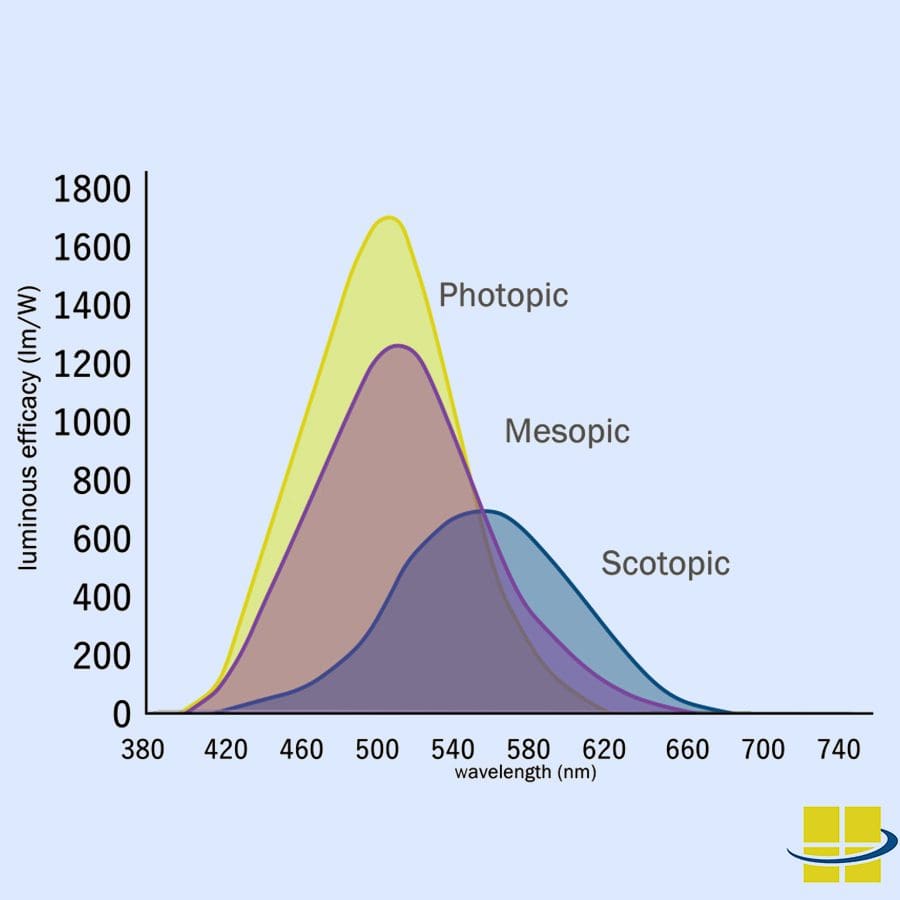
Why is this relevant to selecting an LED fixture? The most common complaint against LEDs is that they are “too bright.” Because of our rods’ sensitivity to the color blue and their strength at low light levels, we can assume that blues and whites will seem more dominant than other colors in low light. We tend to perceive the higher color temperatures of LEDs as brighter than traditional HID light fixtures, such as metal halide or high-pressure sodium, when we see them at night. However, LEDs come in a variety of color temperatures, including cool white (around 6500K) for a crisp, bluish-white light ideal for task areas, bright white (around 4000K) for a daylight-like, energizing effect that enhances blue and green tones, and warm white (around 2700K) for a cozy, inviting atmosphere perfect for decorative or landscape lighting. These options can help account for the often-problematic disparity between photopic and scotopic vision.
Note: When selecting an LED fixture, always consider the color temperature that best suits your application to achieve the desired ambiance and visibility.
When switching between HID and LED, it is better to factor in both kinds of vision. The ratio between a lamp’s scotopic luminance and its photopic luminance is called the S/P ratio. A lamp with a higher S/P ratio will provide sharper vision and better color rendering. To find the actual visibility provided by a fixture, you need to determine the S/P ratio and multiply it by the mean lumens of the luminaire.
See the following table for S/P ratios. Once the S/P ratio is determined, it is time to find the visually effective lumens (VELs), also called pupil lumens or usable lumens. VELs are lumens picked up by our rods and our cones. A quick and effective way to estimate VELs is to multiply the mean lamp lumens by the S/P ratio. In the example of the 250w, 2100K HPS, we would use the following equation: 27,000 x 0.62 = 16,740 VELs.

How Does Luminaire Efficacy Impact Your Selection of LED Equivalent Wall Packs?
Now that we have the VELs of the light source, we will need to determine the luminaire efficacy. The efficacy of a light fixture is its measured ability to provide light. Manufacturers calculate the efficacy of an HID luminaire by dividing the emitted lumens by lamp lumens. The manufacturer of your wall pack will be able to provide this data. For your convenience, an estimate is provided in the following chart.
Unlike incandescent light bulbs, which consume more power to produce the same light output, LED wall packs offer greater efficacy and energy savings. When comparing LED products, be sure to check the lighting facts label, which provides important information about energy use, light output, and longevity to help you make an informed decision.
The housing style affects the efficacy of a wall pack. For example, a traditional wall pack will have greater efficacy than its full cutoff equivalent. If you’re still scratching your head about what this all means, give Access Fixtures a call or email us a picture of your existing fixture. Email [email protected] is the best way to reach us. We’ll be able to estimate its total luminaire efficacy and guide you through the process. The efficacy of our 250w HPS wall pack is 65%.
How Do You Convert Different Types of Bulbs to LED?
Converting different types of bulbs to LED can be a straightforward process, but it’s essential to understand the equivalent wattage (watts) and brightness of the LED bulb. For example, a 60-watt incandescent bulb is equivalent to a 9-watt LED bulb, while a 100-watt incandescent bulb is equivalent to a 12-14-watt LED bulb. Halogen bulbs, compact fluorescent lamps (CFLs), fluorescent lights, and traditional lighting can also be converted to LED lamps, but it’s crucial to choose the correct LED equivalent in watts to ensure the desired level of brightness. Understanding these equivalent wattages helps in achieving the same level of illumination while benefiting from the energy efficiency of LED technology.
Why Should You Use Comparison Charts for LED Equivalents?
Comparison charts can be a valuable tool when converting to LED lighting. These charts provide a side-by-side comparison of traditional bulbs and their LED equivalents, making it easy to choose the correct LED bulb for your needs. Using a comparison chart makes sense for consumers who want to make informed, practical lighting choices based on lumens, wattage, and energy efficiency. By using a comparison chart, you can ensure that you’re getting the right level of brightness and energy efficiency from your LED bulb. Additionally, comparison charts can help you understand the different types of LED bulbs available, including dimmable, smart, and color-changing options. This ensures that you select the best LED bulb for your specific application, whether it’s for home, office, or industrial use.
How Do You Calculate Mean Visible Luminaire Lumens?
Mean visible luminaire lumens is the average number of lumens put out by an LED light bulb over its lifetime. This calculation is typically easy. Multiply the VELs we found in step 3 by the total luminaire efficacy we found in step 4. For the customer with a 250w HID wall pack, the equation would look like this: 16,740 x 65% = 10,881 mean visible luminaire lumens.
How Do You Calculate Mean Visible Luminaire Lumens for LED Fixtures?
Once you know the mean visible luminaire lumens for the HID wall pack, you have to find the same figure for LEDs and compare the two. Easy enough, right?
Surprisingly, because of the differences between HID and LED technology, the calculations for LEDs are slightly different. If you’re not sure which LED fixture to use, a good rule of thumb is to cut the HID wattage in half and use that as a starting point for ideal LED wattage. For example, if you’re looking to replace a 250w HPS wall pack, the closest possible equivalent at half the wattage would be a 126w LED wall pack. Remember, though, that this method only provides an educated guess; after running the following calculations, you’ll likely want to explore different LED wattages to find a better match for your needs. There are various types of LED light bulbs available, each with different wattages and lumen outputs to suit different needs. Take the following steps to find the mean visible luminaire lumens for the LED wall pack.
- Determine the initial light source lumens. Most manufacturers will have data on initial light source lumens on record. A 126w LED array throws 17,724 initial light source lumens.
- Multiply the initial light source lumens by 85% to get the mean lumens. Keep in mind that LED fixtures sometimes use LED chips instead of lamps; for clarity, we’re using “mean lamp lumens” to refer to both styles. Also, recall our earlier discussion on lumen depreciation; LEDs depreciate far less drastically than HID so much so that an LED fixture at 85% of its rated life will perform as well as an HID fixture at 50% of its rated life. 17,724 x 85% = 15,065.4 mean lumens
- Use the S/P ratio chart to select the S/P ratio for the LED lamp. The S/P ratio for a 3000K LED is 1.21, or 121%.
- Multiply the mean lamp lumens by the S/P ratio to find the VELs of the LED fixture. 15,065.4 x 121% = 18,229.13 VELs
- Use the “Luminaire Efficacy of HID and LED Wall Packs” table to determine the efficacy of the LED fixture. The efficacy of a traditional LED wall pack is 83%.
- Find the mean visible luminaire lumens by multiplying the VELs by the efficacy of the light fixture. 18,229.13 x 83% = 15,130 mean visible luminaire lumens

It's important to note that high-temperature environments can affect the performance and lifespan of LED fixtures, so consider the operational environment when selecting LED replacements.
At this point, you should know the mean visible luminaire lumens for both the HID and LED wall pack.
How Do You Compare Lumens and Energy Consumption to Find the Best Replacement?
You are almost ready to shop! If we compare the mean visible luminaire lumens of your existing HID light bulbs and the possible LED equivalent, we will likely find that the LED, even at half the wattage of the HID, will provide far more light than necessary. You should be able to run the numbers for lower LED wattages until you find one that provides similar mean visible luminaire lumens to the existing HID fixture.
What Are The Key Installation and Safety Considerations?
When installing LED bulbs, it’s essential to follow proper safety precautions to avoid injury or damage. Always turn off the power to the light fixture before replacing the bulb, and ensure that the LED bulb is compatible with the existing fixture. If you are installing LED bulbs in a small area, select bulbs with appropriate light distribution to avoid over-illumination and ensure comfortable lighting. Additionally, be aware of any local regulations or restrictions on the use of LED bulbs. It’s also important to dispose of old bulbs properly, as they may contain hazardous materials like mercury. Following these safety guidelines ensures a smooth and safe transition to LED lighting, protecting both you and your property.
What Are The Best Practices for a Successful LED Conversion?
To get the most out of your LED conversion, follow these best practices:
- Choose the correct LED equivalent for your traditional bulb to ensure the desired level of brightness.
- Consider the color temperature and color rendering index (CRI) of the LED bulb to ensure it meets your needs.
- Use a comparison chart to compare different LED bulbs and choose the best option for your application.
- For fixtures installed in high ceilings, opt for long-lasting LED bulbs or LED tube lights to reduce maintenance and take advantage of their energy efficiency and durability.
- Follow proper safety precautions when installing LED bulbs.
- Dispose of old bulbs properly to minimize environmental impact.
By following these best practices, you can ensure a successful LED conversion and enjoy the many benefits of energy-efficient lighting. This approach not only enhances your lighting experience but also contributes to long-term savings and environmental sustainability.
Conclusion
Switching to LED lighting using an LED equivalent chart simplifies the process of upgrading from traditional bulbs like HID, incandescent, or fluorescent lamps. By understanding lumens, wattage, and the specific needs of your application, you can select the right LED bulbs that provide the desired brightness while consuming significantly less energy. LEDs offer superior luminous efficacy, longer lifespan, and reduced maintenance costs, helping you save money in the long run. Additionally, considering factors such as color temperature and light quality ensures a comfortable and efficient lighting environment. Whether for task lighting, decorative purposes, or large-scale upgrades, using an LED equivalent chart is a practical and effective tool to make informed decisions and enjoy the many benefits of LED technology.
Speak to an Access Fixtures Lighting Specialist about Choosing the Right Fixture
We don’t expect you to make all these calculations, and that’s why we’re here. Selecting LED equivalent wall packs doesn’t have to be difficult. Simply enough, we love this stuff and look forward to helping you navigate the transition from HID to LED. Give us a call at (800) 468-9925, and we’ll find you a solution!
LED Equivalent Chart Frequently Asked Questions (FAQs)
What is an LED equivalent chart?
An LED equivalent chart helps you compare traditional bulbs like incandescent, halogen, or HID lamps with LED bulbs by matching brightness levels (lumens) to appropriate LED wattages. This makes selecting the right LED bulb easier and ensures you get the desired light output while saving energy.
Why should I use lumens instead of watts when choosing LED bulbs?
Watts measure energy consumption, while lumens measure visible light output. Since LED bulbs use less energy to produce the same brightness as traditional bulbs, focusing on lumens ensures you select a bulb with the right brightness rather than just matching energy use.
How much energy can I save by switching to LED lighting?
LED bulbs use up to 90% less energy than incandescent bulbs and are generally about 7 times more efficient at producing light. This can translate to significant savings on your electricity bills over time.
Do LED bulbs last longer than traditional bulbs?
Yes, LED bulbs typically last between 10,000 to 25,000 hours, much longer than incandescent bulbs, which last about 1,000 hours. This reduces the frequency and cost of replacements.
What is correlated color temperature (CCT), and why does it matter?
CCT measures the shade of white light emitted by a bulb, expressed in Kelvin (K). Lower values (2700K-3000K) produce warm white light, while higher values (3500K and above) produce cooler, bluish light. Choosing the right CCT affects the ambiance and suitability of lighting for different spaces.
Can I use LED bulbs in dimmable fixtures?
Many LED bulbs are dimmable, but it’s important to use a dimmer switch compatible with your specific LED bulb to ensure proper function and avoid flickering.
Are LED bulbs safe to use in outdoor or high-temperature environments?
LEDs are generally durable and perform well in various environments, but high temperatures can affect their lifespan. Selecting LED fixtures designed for such conditions is recommended.
How do I know if an LED bulb is energy efficient?
Look for the ENERGY STAR label and the Lighting Facts label on the packaging. These indicate that the bulb meets strict energy efficiency and performance standards.
What are LED string lights, and where can I use them?
LED string lights are energy-efficient decorative lights available in various colors and styles, ideal for holiday decorations, patios, and accent lighting with lower energy use and longer lifespan than traditional string lights.
How do I properly dispose of old bulbs when switching to LED?
Traditional bulbs like CFLs contain mercury and require special disposal. LEDs do not contain hazardous materials, but recycling programs are encouraged to minimize environmental impact. Always follow local regulations for disposal.