

Three LED bollard lights. Identical 15w LED arrays. Delivered lumen outputs of 371, 1,022, and 1,384. The only difference is optics.
The optics inside a bollard fixture determine how much of the LED array's output actually reaches the ground, how far that light travels, and how far apart your fixtures need to be spaced. For architects, landscape designers, and specifiers, understanding optic type is not a secondary consideration; it directly determines fixture count, spacing, and project cost.
Key Takeaways
-
-
Role of Optics in Performance: The design of optics in LED bollard lights critically influences the intensity and distribution of light. Optics determine how light is directed and spread, affecting everything from lumens delivered to the area illuminated, making them crucial for effective outdoor lighting design.
-
Variety in Lighting Outcomes: Different types of optics, such as louvered, Type V, and aluminum cone reflectors, offer varying degrees of light distribution and intensity. This variety allows for tailored lighting solutions, enabling precise placement and spacing to meet specific environmental and aesthetic needs.
-
Visual Tools for Decision-Making: False color renderings and light distribution graphs provide valuable insights into how different bollard lights perform in real-world scenarios. These tools assist architects and planners in selecting the right type of bollard lighting to optimize visibility, enhance safety, and reduce light pollution.
-
What Is The Role of Optics in LED Bollard Lighting?
Optics are a pivotal feature in commercial LED bollard lights, dictating the intensity and spread of light emitted by the fixtures. Despite identical internal components such as the 15W LED array, branded LEDs, and the same driver, the distribution and amount of light from these fixtures can vary significantly due to the design of their optics. Why? The answer: Optics.
The light produced by a bollard LED fixture is always affected by the light source's location, the reflector type, and the bollard housing's physical construction. For instance, while three bollard lights employ the same 15W LED array, one emits 1,022 lumens while another throws 2,089 lumens- more than twice as many. Let’s get into the purpose of each specific reflector and the net effect of its optics. View all commercial LED bollard lighting fixtures with the same 15W LED array to compare optic types side by side.
A Means of Comparison
We will present the three different bollard optics in the same way:
- First is an image of false color rendering. It shows the amount of illumination emitted, in color and with footcandle readings. The darker the color, the less light is emitted. Each number on the image represents the footcandles at a specific distance from the bollard. This provides a visual overview of light in a defined area. The area in the false rendering images is 20’ x 20’.
- Each reflector also has a graph that shows the delivered footcandles at various distances from the bollard lights. While the graphs are more precise than the false-color renderings, they do not provide as vivid a graphic.
- You will also see light source lumens and delivered lumens for each type of bollard light optic. Light source lumens will be the same for each of the three bollards. Delivered lumens represent the total light emitted by the bollard light with that optic. The last data point we will provide is the farthest distance from each bollard that is still lit with .5 footcandles, or 0.5 fc.
Click here to compare LED bollard lights vs metal halide bollards - performance and operating cost comparison.
Different Optics, Different Outcomes
Three commercial LED bollard lights, all using the same energy-efficient technology, showcase varied lighting outcomes:
Louvered LED Bollard Light Optics
Louvered LED bollard lights are designed to direct the light down to reduce glare and light trespass. Louvers significantly cut back emitted light and the distance that light can travel. Consequently, louvers emit the least light and have limited light distribution.
Purpose: Designed to direct light downward to minimize glare and light trespass.
Performance: These fixtures emit the least light and have the most limited distribution, achieving a subdued but focused lighting effect. For instance, maintaining adequate lighting levels (.5 footcandles) between louvered bollards requires them to be placed no more than nine feet apart.
Maintaining a minimum of .5 footcandles between two of these louvered bollard lights would require 9' or less spacing.
Array lumens: 2,089
Delivered lumens: 371
Generates .5 footcandles at approximately 5'
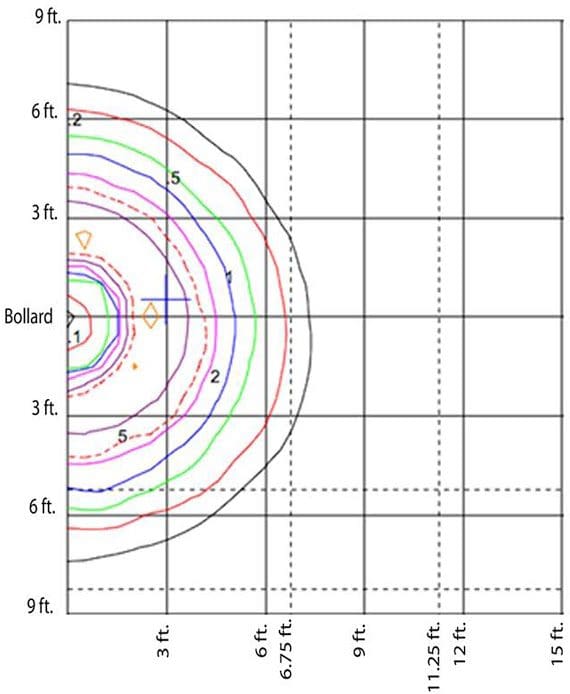
Chart of light emitted by a 15w LED bollard light with louvers
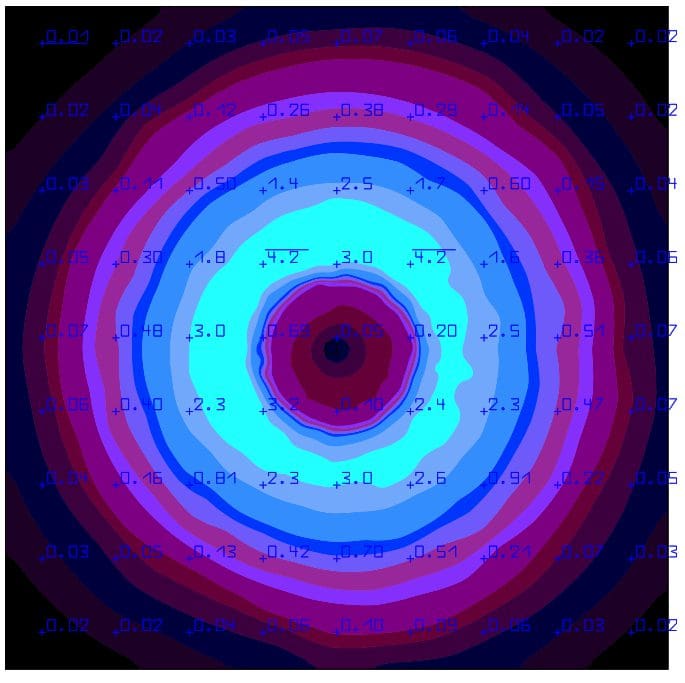
Chart of 20’ x 20’ area illuminated by a 15w LED bollard light with louvers
Type V LED Bollard Light Optics
Type V LED bollard lights are designed to distribute the light out and all around the bollard. With the LED array mounted beneath the top of the unit, the only limit to the light is the clear, prismatic, IES-type V borosilicate glass refractor, which reduces glare. While the refractor reduces glare and doesn’t restrict the light, the amount of light emitted is slightly reduced if compared to the specialized aluminum cone reflector. However, the distribution of light is broader than that of a bollard with an aluminum cone reflector, so deciding between the two is a matter of personal preference.
Purpose: Engineered to distribute light outward and all around the bollard, ideal for expansive illumination.
Performance: Equipped with a clear, prismatic, IES-type V borosilicate glass refractor to reduce glare while not restricting the light spread. This setup allows for a broader light distribution, requiring these bollards to be spaced up to seventeen feet apart for optimal coverage.
Maintaining a minimum of .5 footcandles between two type V optics bollard lights would require 17' or less spacing.
Array lumens: 2,089
Delivered lumens: 1,022
Generates .5 footcandles at approximately 9'
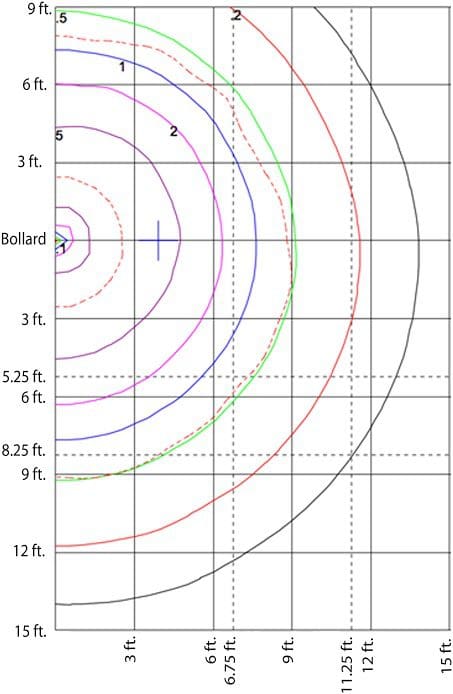
Chart of light emitted by a 15w LED bollard light with Type V glass
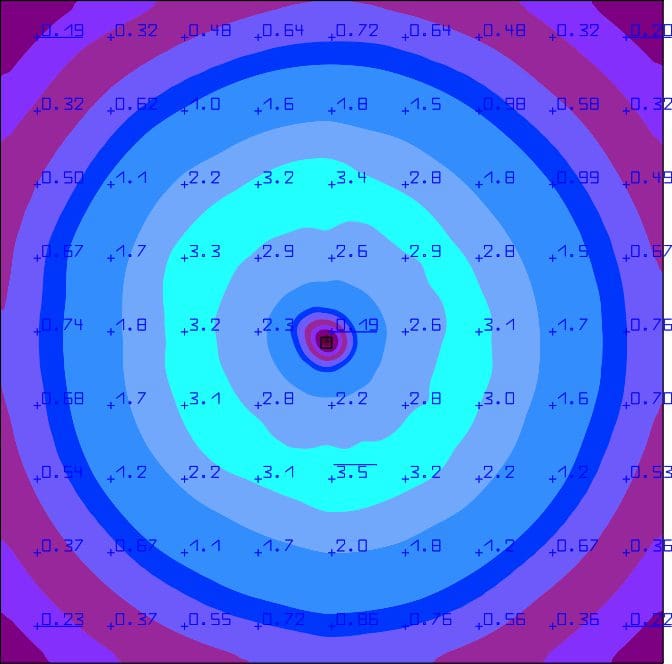
Chart of 20’ x 20’ area illuminated by a 15w LED bollard light with Type V glass
Aluminum Cone Reflector LED Bollard Light Optics
Aluminum cone reflector LED bollard lighting fixtures are designed to direct the light down and out. The intensity of the light is increased by the aluminum cone reflector. As with the other two 15W LED bollard lights, the LED array on this bollard is mounted on the top. While the aluminum cone reflector increases the amount of light, it doesn’t necessarily increase light distribution. If compared with type V optics, choosing between aluminum cone reflector optics and type V optics is a matter of personal preference.
Purpose: Focuses on directing light both downwards and outwards, enhancing the intensity of the emitted light.
Performance: Though it increases the amount of light, the distribution is not as wide as the Type V optics. These fixtures can be spaced about fourteen feet apart to maintain .5 footcandles, combining focused intensity with reasonable coverage.
Not sure which optic type is right for your project? Call an Access Fixtures lighting specialist at 800-468-9925; we will calculate the correct spacing and fixture count for your layout.
Maintaining a minimum of .5 footcandles between two aluminum cone reflector bollard lights would require 14' or less spacing.
Array lumens: 2,089
Delivered lumens: 1,384
Generates .5 footcandles at approximately 7.5'
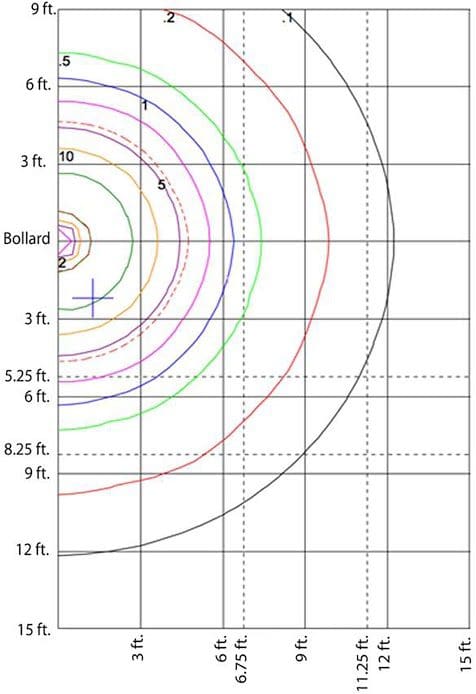
Chart of light emitted by a 15w LED bollard light with an aluminum cone
reflector
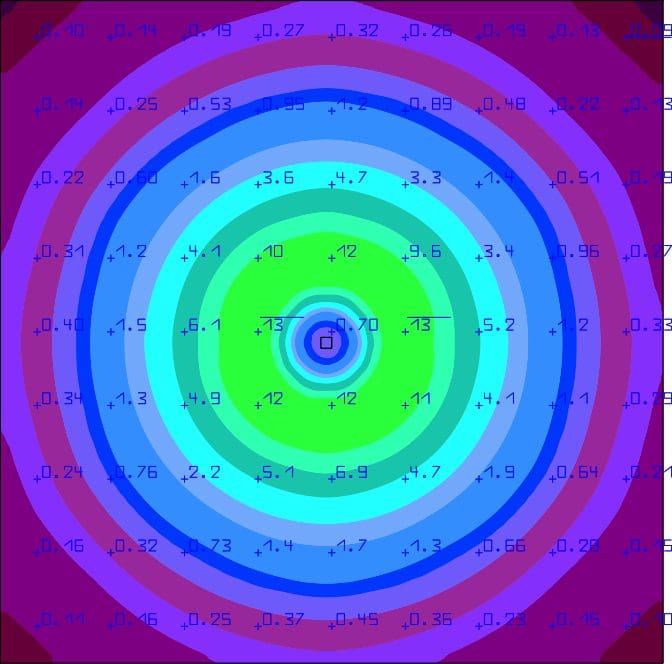
Chart of 20’ x 20’ area illuminated by a 15w LED bollard light with an aluminum
cone reflector
Visualizing the Differences
The impact of each type of optic is further illustrated through false color renderings and detailed light distribution graphs. These visual aids provide a quantitative and qualitative analysis of how light is emitted within a 20' x 20' area. Whether it’s the stark contrast in illumination between the louvered and Type V optics or the nuanced differences in light spread with the aluminum cone reflector, these visuals help in making informed decisions about fixture placement and type selection.
Economic and Environmental Considerations
The efficiency of these LED bollard lights leads to lower energy consumption and contributes to environmental sustainability. By choosing the right type of optic for specific needs, users can enhance night-time visibility while minimizing light pollution and energy wastage.
Learn about LED bollard installation here.
Conclusion
Optics are the single most consequential variable in bollard lighting performance. Two fixtures with identical wattage and LED arrays can deliver lumen outputs that differ by a factor of four. Getting the optic type right before specifying means fewer fixtures, correct spacing, and no post-installation surprises.
Ready to spec your bollard lighting project? Call an Access Fixtures lighting specialist at 800-468-9925 or shop louvered, cone reflector, and prismatic glass bollard lights below.
Frequently Asked Questions About LED Bollard Lighting Fixtures
What are LED bollard lights?
LED bollard lights are a collection of outdoor lighting units typically used to illuminate pathways, walkways, and landscaping areas. They are designed to provide ground-level illumination, enhancing visibility and safety in pedestrian spaces.
Why are optics important in LED bollard lights?
Optics in LED bollard lighting control the direction and spread of light, affecting how well the light covers the intended area. Different optics can drastically alter the amount and distribution of light, making them crucial for achieving specific lighting effects and efficiency.
How do different types of optics in LED bollard lights affect their placement?
Different optics require varying spacing to maintain effective lighting levels:
- Louvered optics typically require closer spacing (about nine feet apart) due to their focused and downward-directed light.
- Type V optics can be spaced further apart (up to seventeen feet) as they distribute light more broadly.
- Aluminum cone reflector optics offer a balance with spacing around fourteen feet, focusing light down and outward.
What are lumens and footcandles in the context of LED bollard lights?
Lumens measure the total amount of visible light emitted by a source (light source lumens), while delivered lumens refer to the actual light reaching the target area after being affected by optics. Footcandles measure the intensity of light on a surface, helping determine how bright the light appears in specific areas.
How do you choose the right LED bollard light for a specific area?
Choosing the right LED bollard light depends on the required lighting level, desired aesthetic, and specific functional needs of the area. Consider light distribution patterns (wide vs. focused), intensity, and potential glare issues. Assessing the space’s dimensions and usage will also guide the selection of the appropriate fixture type and spacing.
Can LED bollard lighting be energy efficient?
Yes, LED bollard lights are highly energy efficient. They use LEDs, which consume less power than traditional lighting technologies, leading to significant energy savings and reduced operational costs over time. To add, the right optics can enhance efficiency by directing light precisely where it is needed, reducing waste.
How does LED bollard lighting contribute to environmental sustainability?
LED bollard lighting reduces energy consumption, which lowers greenhouse gas emissions associated with power production. The longevity of LEDs also means fewer replacements and less waste. Moreover, using directional optics minimizes light pollution, preserving the natural nighttime environment.
Are there any regulations or guidelines for installing LED bollard lighting?
Yes, many regions have guidelines or regulations regarding outdoor lighting, including issues like light pollution, safety standards, and energy use. It's essential to check local codes and standards, which may dictate aspects such as the height of bollard lights, intensity, and spacing for compliance and optimal functionality.