
The 2026 Guide to Solar Security Bollard Retrofit: Professional Perimeter Lighting Without the Trench
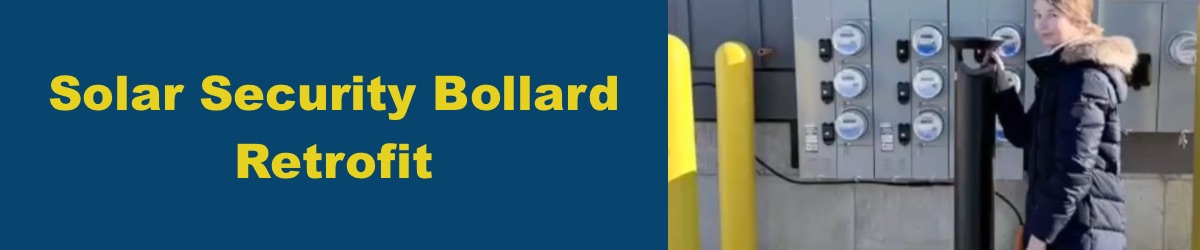
From Passive Barriers to Active Assets: Why Retrofitting is the New Standard
For property owners, municipal planners, and retail facility managers, the "gray pipes" surrounding your building, your security bollards, have traditionally been passive assets. They stop vehicles, but they don't stop crime. Once the sun sets, these unlit barriers create "blind spots" that exploit gaps in your surveillance and harbor security risks. Until now, illuminating a perimeter meant a massive capital expenditure: trenching. In 2026, with labor and material costs at record highs, the "old way" of wiring perimeters is no longer viable. Enter the solar security bollard retrofit. By leveraging the newly launched SECU 3w Solar-Powered Security Bollard Light, you can transform your existing infrastructure into active, high-output security assets in under 30 minutes.
Key Takeaways
-
- Eliminate the "Trenching Tax": Skip the $5,000+ infrastructure costs of traditional wiring; retrofitting existing bollards takes under 30 minutes with zero excavation or permitting required.
- Active vs. Passive Security: Transform "blind spot" barriers into high-output deterrents that enhance CCTV clarity and remain grid-independent even if the main power line is severed.
- Industrial-Grade Longevity: Engineered for 61 years of LED life (L70 at 270,000 hours) with Dark-Sky compliance and marine-grade durability to withstand 2026's harshest environments.
The Crisis: Ram-Raids and the High Cost of "Dark" Perimeters
Across the United States, ram-raids and vehicle-based break-ins are surging. Retail storefronts and warehouses are being targeted specifically in "blind spots" where physical bollards exist, but illumination is absent.
As Steven Rothschild, CEO of Access Fixtures, recently noted:
“Security bollards have long been used to stop vehicles, but until now they have remained largely passive. SECU turns existing security bollards into solar security bollard lights by adding powerful lighting quickly, sustainably, and without the need for a single inch of conduit.”
Why Perimeter Security Lighting Without Wiring is the 2026 Standard:
- Zero Site Disruption: Traditional trenching blocks entrances, tears up asphalt, and requires weeks of permitting.
- Anti-Ram Resilience: Wired lighting is vulnerable. If a vehicle or storm severs a main line, the entire perimeter goes dark. A solar retrofit is grid-independent; if one unit is hit, the rest stay illuminated.
- CCTV Enhancement: Security cameras are only as good as the light they receive. Localized light at the bollard line eliminates "washing out" and improves facial recognition.
Technical Superiority: What Makes a Professional Retrofit?
Not all solar lights are created equal. For a solar security bollard retrofit to be viable for municipal and commercial use, it must meet rigorous engineering standards. The SECU 3w is purpose-built for this transition.
1. EXTREME-LIFE LED Performance
The SECU features an LED module rated for L70 at 270,000 hours. To put that in perspective, that is roughly 61 years of dusk-to-dawn operation. You aren't just buying a light; you are installing a permanent security fixture. More about L70 LED Lifetime Rating
2. Precision Optics & Dark-Sky Compliance
With a BUG rating of B0-U1-G0, the SECU ensures that all 390 lumens are directed exactly where they are needed: on the ground. This prevents "light trespass" into neighboring properties, a critical requirement for municipal planners and HOA boards. More about BUG Rating
3. Specialized Spectral Options
- Standard CCTs: Available in 3000K, 4000K, and 5000K to match existing site lighting.
- Wildlife Friendly: A 590nm Amber option is available for turtle-friendly coastal applications or wildlife-sensitive zones.
4. Rugged Durability
Perimeters are harsh environments. The SECU is built with:
- IK07 Impact Rating: Resistance to vandalism and accidental contact.
- Marine-Grade Powder Coat: Protection against salt spray and corrosion.
- Vandal-Resistant Mounting: Specialized security screws prevent unauthorized removal.
Speak to an Access Fixtures Lighting Specialist to Convert Your Safety Bollards into Security Bollard Lights - Call (800) 468 9925


Comparison: The "Trenching Tax" vs. SECU Retrofit
When budgeting for your next security upgrade, the "Trenching Tax" is the hidden fee that kills projects.
| Cost Factor | Traditional Wired Bollard | SECU Solar Retrofit |
| Installation Time | 3-5 Days | 30 Minutes |
| Infrastructure Cost | $3,500 - $7,000 (Average Run) | $0 |
| Labor Requirement | Licensed Electrician + Excavator | 1 Maintenance Staff |
| Energy Cost | Monthly Utility Fees | $0 (Forever) |
| Permit Requirements | Electrical & Excavation Permits | None |
Conclusion: Turning "Invisible" Pipes into Active Deterrents
The era of the "passive" perimeter is over. For property owners and managers, a solar security bollard retrofit is the fastest, most cost-effective way to harden a site against 2026’s security challenges. By eliminating trenching and utilizing EXTREME-LIFE LEDs, the SECU 3w ensures your facility is visible, safe, and secure.
Ready to Upgrade Your Perimeter?
Don't wait for a security breach to realize your bollards are invisible at night.
Solar Security Bollard Retrofit Frequently Asked Questions (FAQs)
General & Installation
1. How exactly does the SECU "retrofit" an existing bollard?
The SECU 3w is designed as a self-contained "cap" unit. It replaces the existing decorative or flat cap of a standard 6" or 8" steel pipe. It is secured using vandal-resistant security screws that bite into the interior of the bollard, requiring no external hardware or welding.
2. Does "30-minute installation" include the time to remove the old cap?
Yes. For a standard maintenance crew, removing a set screw or prying a press-fit cap takes roughly 5–10 minutes. Slotted placement and securing the SECU unit takes another 10–15 minutes. No specialized electrical certification is required.
3. Will the light still work during a week of heavy rain or snow?
The SECU 3w is engineered with "Intelligent Energy Management." During periods of low solar gain, the internal controller automatically dims the output to ensure the battery lasts through the night, maintaining a "glow" for visibility even if it cannot hit full 390-lumen output.
Technical & Compliance
4. Is the SECU 3w compatible with Dark-Sky ordinances?
Absolutely. With a BUG rating of B0-U1-G0, the unit emits zero "up-light." This makes it ideal for HOAs, municipal parks, and LEED-certified buildings where light pollution is strictly regulated.
5. How does the battery handle extreme temperatures?
In 2026, we will utilize Advanced LiFePO4 (Lithium Iron Phosphate) batteries. These are significantly more stable than traditional lithium-ion, capable of discharging in temperatures ranging from -20°C to 60°C without significant degradation.
6. What is the actual lifespan of the LED module?
The module is rated for L70 at 270,000 hours. This means that after 61 years of nightly use, the LEDs will still provide 70% of their original brightness. In practical terms, the housing or the battery will reach its end-of-life long before the LEDs do.
Security & Financials
7. Can a vehicle impact disable the light?
Because the units are independent, a "ram-raid" that destroys one bollard will not affect the rest of the perimeter. This is a primary advantage over wired systems, where a single severed line can plunge an entire storefront into darkness.
8. Is there a "turtle-friendly" or wildlife-safe version?
Yes. We offer a specialized 590nm Amber LED option. This specific wavelength does not disrupt the nesting habits of sea turtles or the migratory patterns of birds, making it compliant with coastal lighting codes.
9. What is the typical "Payback Period" vs. a wired installation?
When accounting for the "Trenching Tax" permits, excavation, copper wiring, and an electrician's labor, the SECU 3w typically pays for itself the moment it is installed. You avoid an average upfront infrastructure cost of $4,000-$6,000 per 100 feet of perimeter.