
LED lighting is now the standard across commercial, industrial, and outdoor applications. But as LED technology has matured, so has the science of measuring how useful that light actually is to the human eye. Scotopic lumens, photopic lumens, and the scotopic/photopic ratio (S/P ratio) are the data points that determine how much of a fixture's lumen output translates into useful visual perception. Understanding these terms can help you select fixtures that deliver more effective light with less wattage.
Visual Perception Is a Combination of Scotopic Vision and Photopic Vision
The first step to understanding this data is to review the ways our eyes perceive light. We know light enters our eyes through the corneas, where it is then focused on the retina. The retina consists of millions of cells called photoreceptors. These light-sensitive cells are broken into two types: rods and cones.
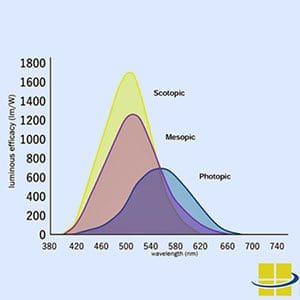
Cones function best in bright light (luminance levels above approximately 5.0 cd/m2), while the rods are primarily responsible for functioning in low light levels, also known as scotopic conditions (below approximately 0.005 cd/m2).
High light levels that engage the cones in our eyes are referred to as photopic light levels. Lower light levels that engage the rods are referred to as scotopic light levels. Our photopic vision has excellent color discrimination. Our scotopic vision is most sensitive to the color blue, but otherwise has a very poor ability to distinguish colors.
What we typically think of as “normal” vision is a result of the overlap of photopic and scotopic vision. This region is called the mesopic range.
For years, scotopic vision was less understood than photopic vision. It was believed that rods were ineffective when measuring lumen output because they only became active in very low light. Because of this, commercial photometric standards were (and still are) weighted in favor of photopic vision. Photopic vision has long been the only part of the visual spectrum people consider when measuring luminous efficacy.
However, modern developments in lighting technology and our understanding of light perception show that scotopic and photopic vision are not mutually exclusive and that rods are active in both low light and interior light levels.
S/P Ratios: Why Do They Matter?
To accurately measure outdoor lighting, we should consider light in the mesopic range. To get an idea of how this affects our perception of light, we can picture an old high-pressure sodium street lamp. The light from this kind of fixture is dim and appears orange in color. An LED street light, on the other hand, will appear much brighter. This apparent brightness is due to the active use of the rods in our eyes, which are able to see much better in blue light; this is why we tend to perceive the LED light as being brighter.
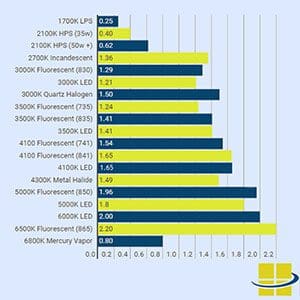
The S/P ratio is particularly important under scotopic conditions, where the human eye relies more on rod cells to perceive light. The scotopic/photopic ratio, or S/P ratio, is a multiplier that measures how much emitted light is useful to the human eye. These useful lumens are known as visually effective lumens (VELs).
A lamp with a higher S/P ratio, like one using 5700K LEDs, will provide sharper vision both indoors and outdoors, as well as better color rendering. This kind of lamp provides more visually effective lumens for our eyes to process.
How Does This Help Us When Choosing Outdoor Lighting?
When choosing outdoor lighting, it is possible to overpay for power you don’t actually need. Considering scotopic conditions is crucial when choosing outdoor lighting, as it affects how the human eye perceives light in low-light environments. If you make a purchasing decision using only photopic lumens, you may end up with an overpowered luminaire. A lower-wattage LED fixture could have saved you money, operated more efficiently, and provided you with all the light you need.
S/P Ratios by Lamp Type
The table below shows S/P ratios for common lamp types at different Kelvin temperatures. A higher S/P ratio means more of the fixture's lumen output is visually effective and useful to the human eye under the mesopic lighting conditions common in outdoor and low-ambient indoor environments.
Use this table when comparing fixtures for outdoor area lighting, parking lot lighting, sports lighting, and any application where human visual perception under low-ambient conditions is a factor in fixture selection. To determine the LED equivalent for your current HID fixtures, see How to Upgrade to LED Wall Packs - HID to LED Conversion. While this page is written about wall packs, the methodology is the same for all luminaires.
Speak to an Access Fixtures Lighting Specialist about Choosing the Right Fixture
Want to know the S/P ratio for a specific Access Fixtures LED fixture and how it compares to your current lamps? A lighting specialist will walk you through the comparison and confirm whether a lower-wattage LED replacement delivers more visually effective lumens for your application. Call 800-468-9925.