
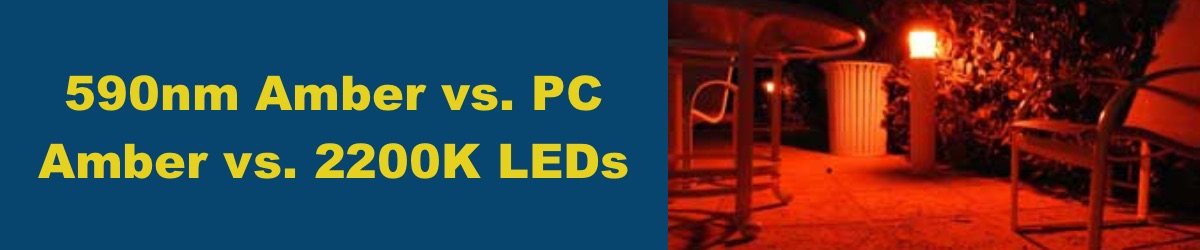
LED PC Amber is a phosphor-converted amber LED that balances wildlife protection with moderate color rendering, making it a common choice for outdoor lighting in environmentally sensitive areas where both ecological safety and human visibility matter. When choosing outdoor lighting for coastal sites, wildlife corridors, and other dark-sky locations, the specific LED type can have a major impact. Understanding the differences between 590nm Amber, PC Amber, and 2200K LEDs is crucial for property owners, lighting professionals, municipalities, and anyone responsible for selecting compliant lighting near habitats affected by artificial light.
Each light source offers a different balance between wildlife safety, human visibility, and regulatory compliance. Selecting the right one depends on your site’s location, wildlife sensitivity, and ordinance requirements, especially where sea turtle, bat, insect, or dark-sky protections apply. This comparison explains how 590nm Amber, PC Amber, and 2200K LEDs differ in spectrum, color rendering, environmental impact, and appropriate use so you can choose lighting that protects wildlife, supports safety, and meets local regulations.
Not Sure Which Amber LED Your Project Requires?
View FWC-Compliant Lighting, PC Amber, and 2200K Fixtures Engineered for Coastal & Dark-Sky Compliance.
Key Takeaways
-
- 590nm Amber LEDs offer the highest level of wildlife protection, especially for sea turtles, by emitting a narrowband amber light that minimizes disruption but provides poor color rendering for human vision.
- PC Amber LEDs balance wildlife safety and human usability, providing moderate color rendering while significantly reducing the impact on bats, insects, and other nocturnal animals, making them suitable for areas with moderate wildlife sensitivity.
- 2200K LEDs deliver the best color rendering and human visibility among amber LED types, ideal for rural or historic areas where environmental impact is a concern but color accuracy is important; however, they are not suitable for sensitive coastal wildlife zones.
Introduction to LED Lighting
LED lighting has transformed the way we light up our world, offering a perfect solution for those seeking both efficiency and environmental responsibility. Unlike traditional lighting, LED technology uses a fraction of the energy to produce the same quantity of light, making it an ideal choice for anyone looking to reduce energy costs and environmental impact. LEDs are also built to last, with many products featuring lifespans of 50,000 hours or more, far outpacing older lighting technologies.
When it comes to amber LED light, especially PC amber LED and 590nm amber, these benefits are even more pronounced. PC amber LEDs are designed to provide a specific type of light that is safer for wildlife and better for dark-sky preservation, making them the ideal way to illuminate sensitive areas without disturbing nature. Whether you’re lighting a coastal property, a nature preserve, or a residential area, choosing the right amber LED can make a significant difference in both safety and environmental impact. By making the switch to LED, you’re not only saving energy but also helping to protect wildlife and maintain the natural beauty of your surroundings.
Need Help Matching Your Site to the Correct Spectrum?
Speak to an Access Fixtures Lighting Specialist About Compliance Requirements at (800) 468 9925.
Quick Answer: Which Light Is Best?
590nm Amber
The best and safest choice for wildlife, especially sea turtles. This narrowband wavelength is often the only type legally permitted in coastal areas such as Florida. Its major trade-off is “dismal” color rendering, meaning colors are very difficult to distinguish. It’s a perfect choice when wildlife safety outweighs human visual comfort.
PC Amber
A good compromise between wildlife protection and human usability. Significantly safer for wildlife (such as bats and insects) than white light, while offering moderate color rendering. PC Amber works well in areas where color recognition is still important, but wildlife sensitivity is moderate.
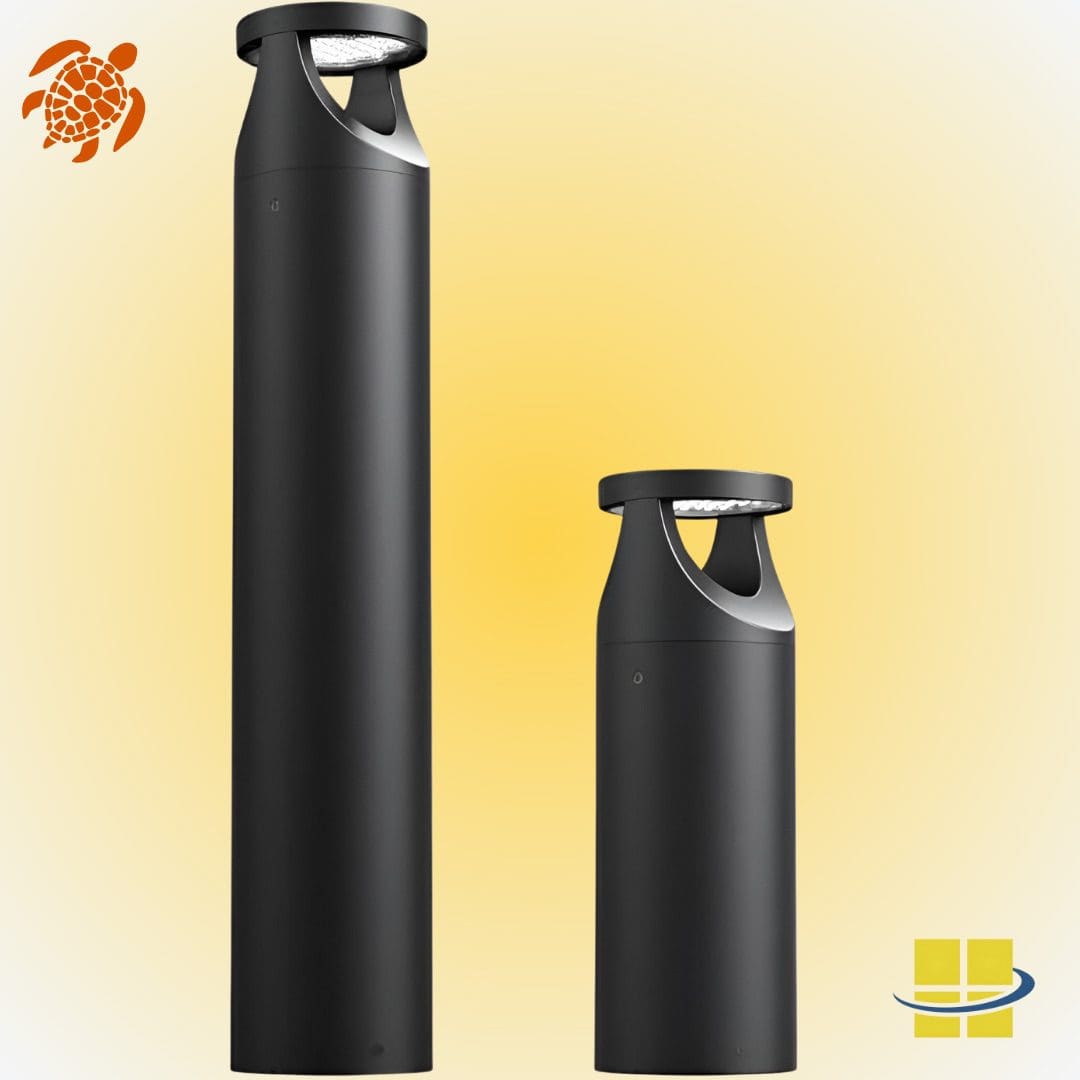
Shop PC Amber LED Bollard Lights
2200K LED
A warm, “dark-sky friendly” white light that mimics the glow of traditional High-Pressure Sodium (HPS). It provides the best color rendering of the three, making it ideal for general outdoor use in rural or historic districts where wildlife is a consideration, but not the primary concern.
Spectral and Technical Comparison
The key differences among 590nm Amber, PC Amber, and 2200K LEDs come from their Spectral Power Distribution (SPD) the “recipe” of light wavelengths they emit. This affects color temperature (CCT), color rendering (CRI), and biological impact (Melanopic DER).
| Feature | 590nm Amber LED (Narrowband) | PC Amber LED (Phosphor-Converted) | 2200K LED (Warm White) |
|---|---|---|---|
| Spectral Type | Narrowband / Monochromatic | Phosphor-Converted | Full-Spectrum White |
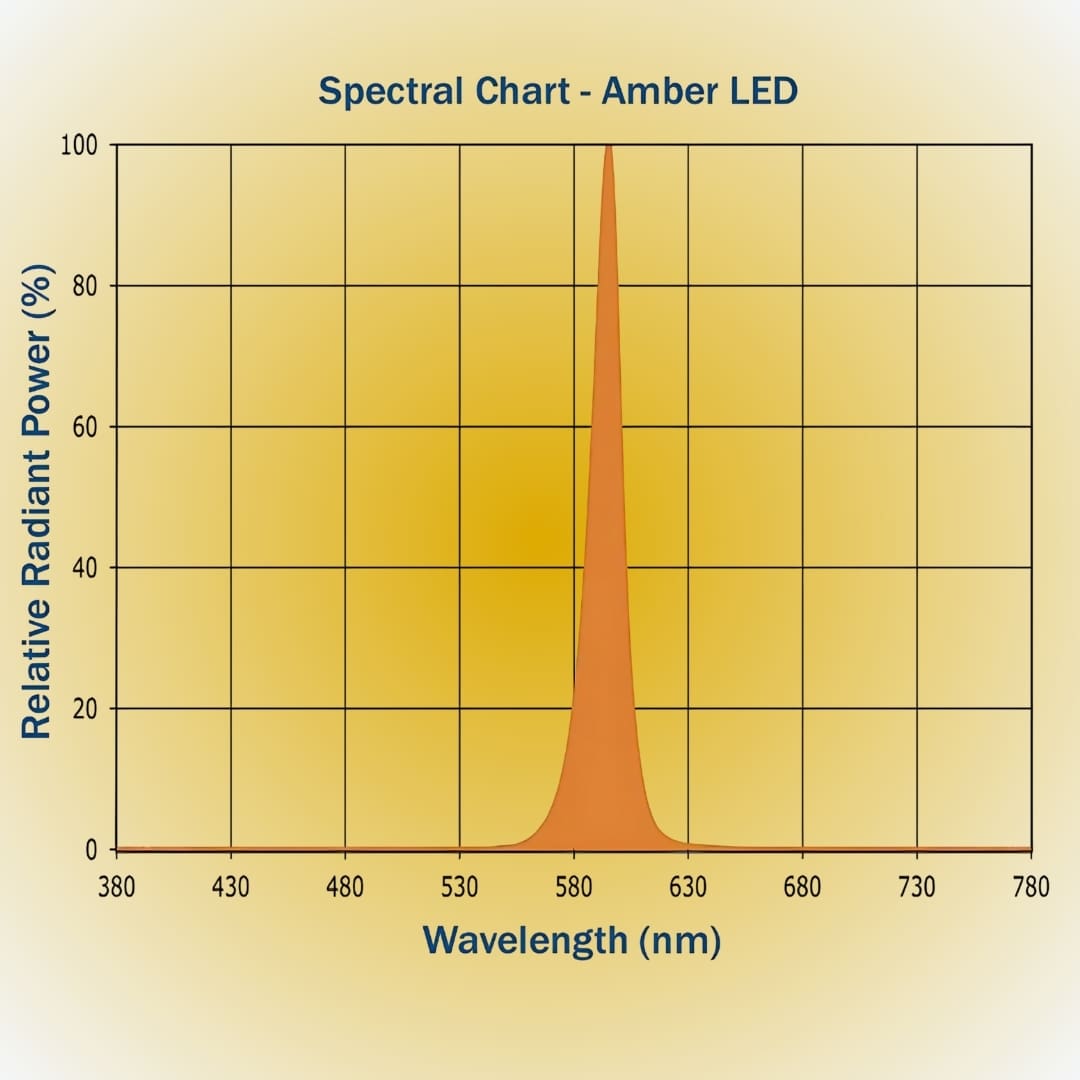
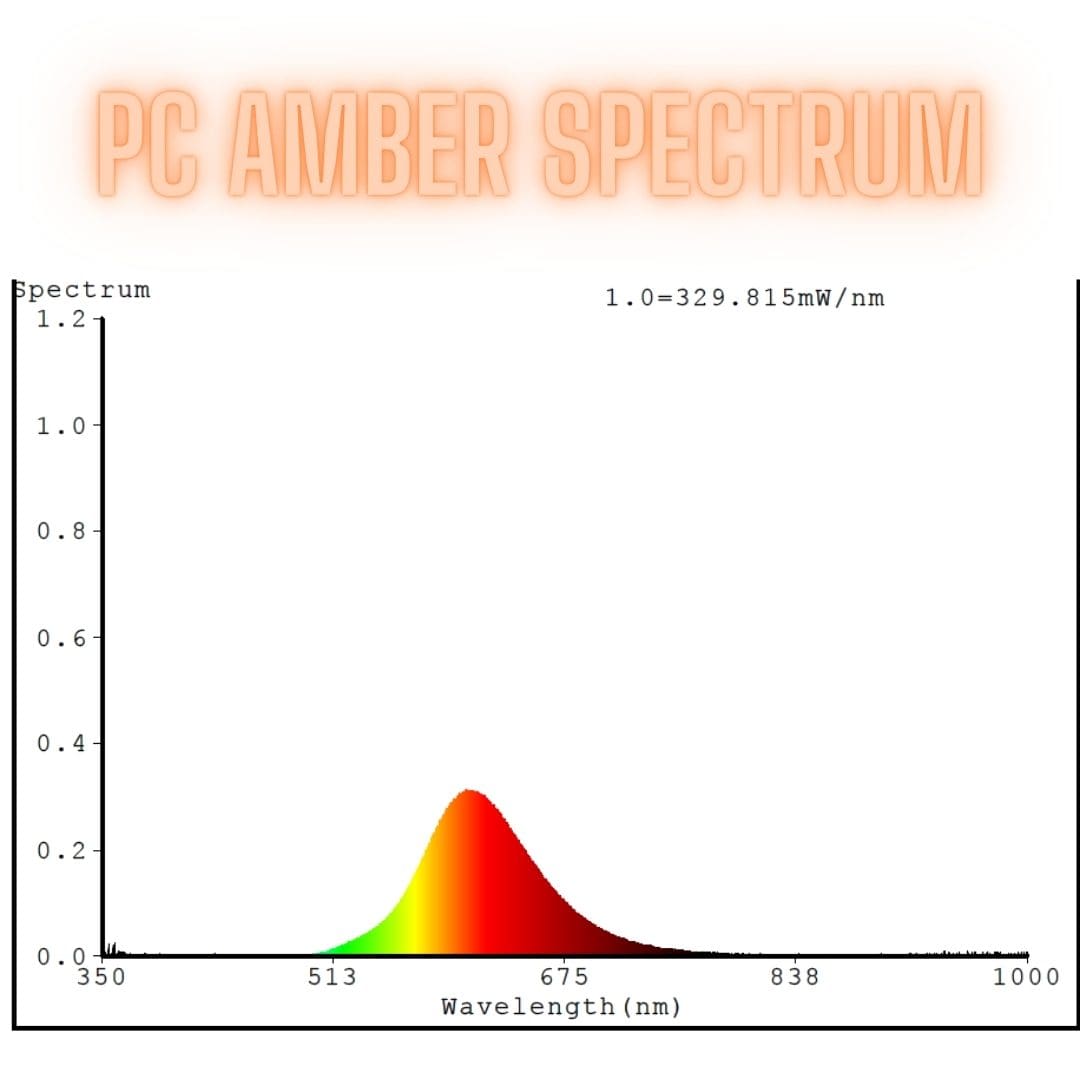
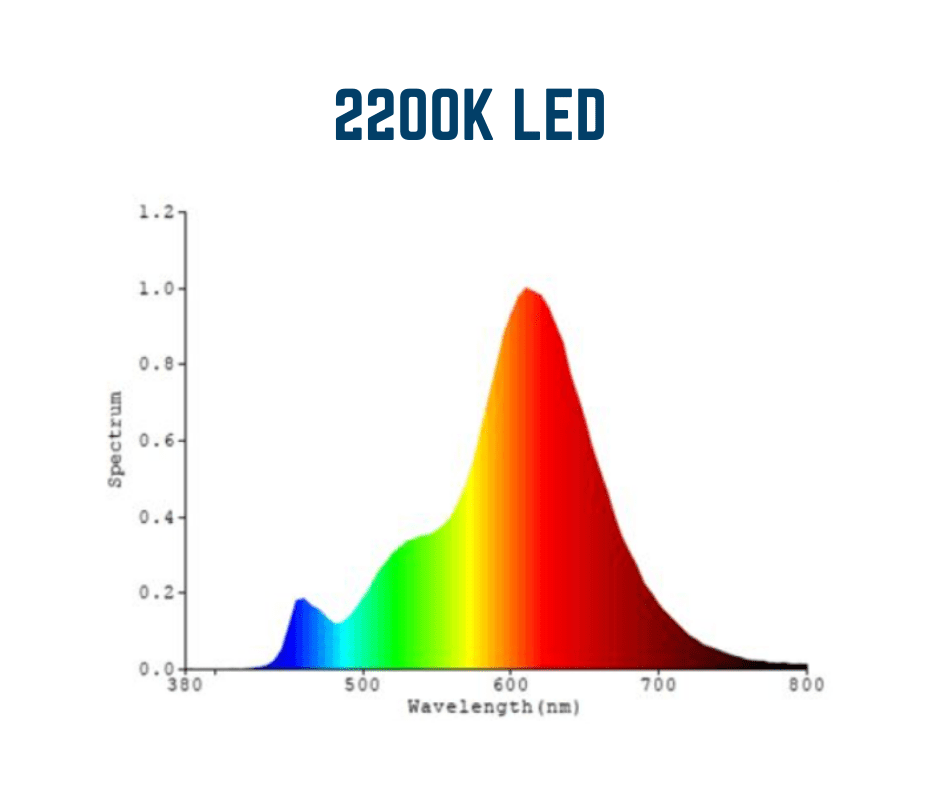
| CCT / Wavelength | 590–595 nm | ~1872 K | ~2200 K |
| Color Rendering (Rf / CRI) | Very Poor (Rf = 2) | Moderate (Rf = 46) | Good (70–80+) |
| Melanopic DER | Very Low (0.02) | Very Low (0.07) | Low (≤0.3) |
| Blue / UV Content | None (<450 nm) | Low (<560 nm) | Low |
The Access Fixtures PC Amber LED collection is a leading example of high-efficacy, temperature-stable amber LED technology, often used in retrofit and specialty lighting applications.
A. Spectral Purity vs. Color Rendering (CRI)
590nm Amber LED
A true monochromatic source emitting light only in the 590-595 nm amber-orange range. Because it lacks all other wavelengths (such as blue, green, or red), its ability to render colors is extremely poor (Rf = 2). However, it produces no blue or ultraviolet light, making it the purest and most wildlife-safe option.
PC Amber LED
A blue LED coated with phosphor to produce an amber appearance (~1872K). It looks amber to the human eye, but technically still emits a small amount of short-wavelength light. Its color fidelity (Rf = 46) is significantly better than 590nm Amber, providing moderate visual comfort while maintaining a low wildlife impact.
2200K LED
A warm, full-spectrum white light engineered to replicate the warm tone of High-Pressure Sodium lamps. Unlike traditional HPS, which has a low CRI, a 2200K LED can achieve CRI values of 70-80+, giving it excellent color rendering while maintaining a low blue light component.
B. Melanopic Content (Biological Impact)
The Melanopic Daylight Efficacy Ratio (DER) measures how much a light source stimulates biological receptors sensitive to blue-cyan wavelengths. These receptors influence circadian rhythms in both humans and wildlife. Lower DER values indicate less biological disruption.
- 590nm Amber LED: DER = 0.02 (virtually no circadian impact)
- PC Amber LED: DER = 0.07 (excellent for minimizing disruption)
- 2200K LED: DER ≤ 0.3 (low compared to standard white LEDs)
All three of these options dramatically outperform cool white LEDs (e.g., 4000K), which have much higher DER values and pose greater risks to nocturnal species.
Wildlife Impact: A Geo-Targeted Guide
Different regions and species have different sensitivities to artificial light. Local regulations often reflect this, particularly in coastal areas where wildlife protection is strictly enforced.
In addition to selecting the correct LED type, fixtures should be mounted low to the ground and shielded to reduce light pollution further and minimize disturbance to wildlife, as recommended by FWC-certified lighting guidelines.
Sea Turtles (Florida, Georgia, Texas Coasts)
This is the most critical application for specialized long-wavelength lighting. Sea turtle hatchlings instinctively move toward the brightest horizon, typically the moonlight over the ocean. Artificial light, particularly white or blue-green light, can disorient them and lead them inland toward roads or buildings.
Coastal Project in a Turtle Zone?
Ensure 100% FWC Sea Turtle Lighting.
590nm Amber LED:
The gold standard for sea turtle protection. Sea turtles are least sensitive to this wavelength, allowing hatchlings to find their way safely to the ocean. It is the wavelength approved by the Florida Fish and Wildlife Conservation Commission (FWC).
PC Amber and 2200K LEDs:
Not typically compliant in direct line-of-sight coastal nesting zones. PC Amber may emit some shorter wavelengths, and 2200K LEDs, while warm, still produce a broad white spectrum that can disorient hatchlings.
Nocturnal Mammals and Bats
Bats and nocturnal mammals rely on vision adapted for low light and are highly sensitive to blue-green light. Artificial lighting can alter their feeding behavior, navigation, and reproduction.
590nm Amber & PC Amber:
Both are suitable for areas near bat habitats or nature preserves. Their long-wavelength emissions are far less disruptive to bat activity than white light.
2200K LED:
Still a viable option in rural environments where bats are present but not in high density. Its low blue output makes it more wildlife-friendly than standard white LEDs.
Invertebrates (Insects) and Skyglow
Short-wavelength (blue and UV) light attracts insects and contributes to skyglow, a major source of artificial light pollution.
All three options, 590nm Amber, PC Amber, and 2200K, dramatically reduce skyglow and insect attraction because they emit minimal to no blue light. However, some insects (e.g., beetles and flies) may still be attracted to amber light.
The only perfect solution for wildlife is, of course, no light at all, but when lighting is required, amber LEDs are the best available compromise.

Summary: The Key Trade-Off
Your lighting decision depends on whether your top priority is wildlife safety or human color perception.
Still Unsure Which Spectrum Is Right?
Compare Fixtures Side-by-Side by Application, Mounting Type, and Output.
590nm Amber
- Pro: Maximum wildlife protection; FWC-approved.
- Con: Dismal color recognition (Rf = 2). Use only where wildlife protection is the top priority.
PC Amber
- Pro: Strong wildlife protection with moderate color rendering (Rf = 46).
- Con: Not a “true” amber and not legal in sea turtle nesting zones.
2200K LED
- Pro: Excellent color rendering (CRI 70-80+), “dark-sky friendly.”
- Con: Still a white light; not compliant in sensitive habitats.
Final Recommendation
Before selecting any lighting solution, review your local lighting ordinances.
- Coastal properties (Florida, Georgia, Texas): 590nm Amber is typically required by law for all sea turtle protection zones.
- Rural or dark-sky communities: 2200K LED provides good visibility and color rendering while minimizing skyglow.
- Transitional areas or mixed-use zones: PC Amber offers a strong balance between ecological protection and human usability.
Future Developments in LED Lighting
The future of LED lighting is bright, with ongoing advancements set to make these lights even more effective and versatile. Researchers and manufacturers are continually refining the color temperature and spectral output of LEDs, enabling even more precise control over the emitted wavelengths. This means that future amber LED lights, including PC amber LEDs, will be able to replicate natural light more closely while further minimizing their impact on wildlife.
Innovations in phosphor technology are also making it possible to produce LEDs with higher color rendering index (CRI) values, improving visibility and safety for people without sacrificing the needs of animals and the environment. As demand grows for wildlife-friendly lighting, we can expect to see a greater number of products specifically designed for sensitive habitats, making it easier for property owners and municipalities to find the perfect solution for their needs.
Additionally, improvements in manufacturing and increased availability mean that these specialized LEDs will become more affordable and accessible, allowing more people to make informed choices about the type of light they use. As technology continues to evolve, the difference between traditional lighting and modern LED solutions will only become more pronounced, offering new ways to balance human needs with the protection of nature.
Additional Resources and Information
If you’re interested in learning more about amber LED light, PC amber LED, or 2200K LED products, there are plenty of resources available to help you make the right choice. Many manufacturers and retailers offer detailed product reviews, technical guides, and comparison charts to help you find the ideal lighting solution for your specific needs. You can also shop online for a wide selection of amber LEDs, PC amber, and other wildlife-friendly lighting options.
For those with questions about compliance or safety, regulatory bodies such as the Florida Fish and Wildlife Conservation Commission provide up-to-date information on approved lighting for sensitive habitats. Reading customer reviews and expert articles can also help you understand the real-world performance of different products, making it easier to select the right LED light for your property.
Whether you’re looking to protect wildlife, improve safety, or simply find a more energy-efficient way to light your space, taking the time to review your options and read up on the latest developments is the best way to ensure you make an informed decision. If you have specific questions or need help with your selections, don’t hesitate to reach out to lighting professionals or consult with local authorities to find the perfect product for your needs.
590nm amber vs PC amber vs 2200K LEDs Frequently Asked Questions (FAQs)
What is the best LED light for sea turtle protection?
The 590nm Narrowband Amber LED is the safest and most effective choice. It emits light at a wavelength that sea turtles barely perceive, preventing hatchling disorientation. This wavelength is certified by the Florida Fish and Wildlife Conservation Commission (FWC) and is legally required for coastal properties in turtle nesting regions.
Why is 590nm Amber better than PC Amber for sea turtles?
590nm Amber is a monochromatic light source; it emits only long-wavelength amber light. PC Amber, on the other hand, uses a blue LED coated with phosphor. While it looks amber, it can still leak small amounts of shorter (blue-green) wavelengths that sea turtles can detect. This makes PC Amber unsuitable for regulated nesting areas.
What is PC Amber used for if it’s not turtle-safe?
PC Amber is ideal for non-coastal environments where wildlife protection is important, but regulations are less strict. It’s safer for bats, insects, and nocturnal mammals, while providing better human visibility than pure 590nm Amber.
When should I use 2200K LED lighting?
Use 2200K LEDs when human visibility, safety, and color rendering are the main prioritie,s but you still want to minimize environmental impact. 2200K LEDs are excellent for rural areas, residential developments, historic districts, and public parks. They are not approved for sea turtle nesting beaches.
What is CRI (Color Rendering Index) and why does it matter?
CRI (or Rf) measures how accurately a light source displays colors.
590nm Amber: CRI ≈ 2 (colors appear brown or gray)
PC Amber: CRI ≈ 46 (moderate color fidelity)
2200K LED: CRI 70–80+ (accurate, natural color perception)
A higher CRI improves visual comfort for humans but usually means more spectral content, which can increase wildlife impact.
What is Melanopic DER, and how does it relate to wildlife?
Melanopic DER measures how strongly a light activates blue-sensitive photoreceptors that influence circadian rhythms in animals and humans. A low DER means less disruption. 590nm Amber has the lowest DER (0.02), followed by PC Amber (0.07) and 2200K (≤0.3).
Why is blue light from LEDs harmful to wildlife?
Blue and cyan light (shorter wavelengths) are strong biological triggers. They disorient sea turtles (who mistake them for moonlight), disrupt bat navigation, attract insects, and intensify artificial skyglow. Minimizing blue content preserves natural nocturnal behavior and the integrity of dark-sky environments.
Are all “amber” LEDs the same?
No. The term “amber” is often used loosely. True 590nm Amber LEDs emit a narrowband wavelength around 590-595nm. PC Amber LEDs only appear amber due to phosphor coating and may emit a small portion of shorter wavelengths. Always check technical specifications or local compliance requirements before purchase. Note: verify technical specifications and compliance requirements rather than relying on the word “amber” alone.
Can I use 2200K LEDs to comply with dark-sky regulations?
Yes. Most dark-sky ordinances allow warm-white lights with a color temperature of 2200K or lower. These emit very little blue light and are ideal for minimizing skyglow while maintaining color visibility for pedestrians.