
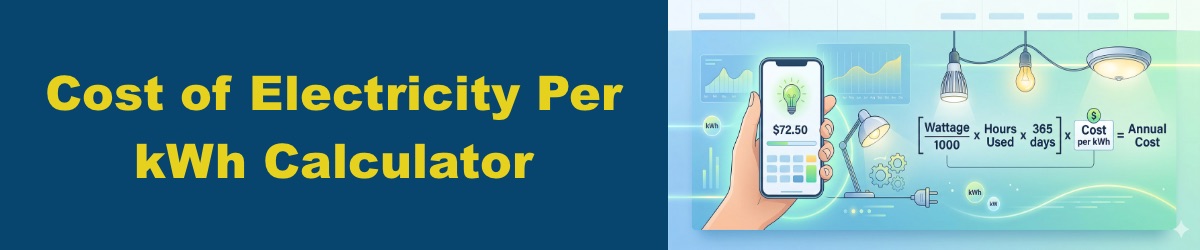
Knowing how to calculate the annual electricity cost of a light fixture helps you make the right specification decision. An LED fixture rated at 50 watts and a metal halide equivalent rated at 112 watts may produce similar light output, but their operating costs over 10 years are not comparable. Even if the LED fixture costs more upfront, the electricity savings typically recover that difference within the first year or two.
This page covers how to find your cost per kWh, how to calculate annual fixture electricity cost, and a worked example comparing a 150-watt metal halide wall pack against a 21-watt LED replacement. Use the calculator above to run the numbers for your specific fixtures.
How Do I Find My Light Fixture Electricity Cost?
The operating cost of a traditional lamp includes electricity and the price of replacing the light every 10,000 to 15,000 hours of use, depending on the average life expectancy of the specific lamp. LED lamps, boards, and chips can operate for over 100,000 hours before needing to be replaced. Still, the highest and most important cost of operating a light fixture is electricity. To find the cost of electricity required to operate a light fixture, you will need to first find the cost of your electricity per kilowatt-hour (kWh).
Electricity rates can vary significantly based on your geographic location, the time of day, and the type of electricity plan you have, such as fixed-rate, variable-rate, or time-of-use plans. Different rates may apply depending on your provider, and utility energy rates often differ by state due to market regulation (regulated vs deregulated), as well as by customer class and time of consumption. Comparing electricity plans and rates can help you find the most cost-effective option for your specific energy usage.
You can use an electricity calculator to estimate your electricity costs. Many electricity calculators allow you to customize your inputs based on specific appliances and your usage habits, making it easier to assess your monthly energy consumption and compare electricity rates.
Annual Electricity Cost Calculator
Estimate the annual electricity cost to operate your light fixture.
*This calculator estimates fixture electricity cost only. It excludes poles, trenching, wiring, or maintenance costs.
Find the Cost of Electricity per Kilowatt-Hour (kWh)
To find your cost of electricity per kWh, you will need a copy of your most recent electricity bill. With the bill in hand, here is how to calculate the cost per kWh:
- Find the cost of electricity from your monthly electricity bill. Use the total cost, as it allows you to include all of the charges that are being assessed. For example, the total cost of a National Grid bill in Massachusetts includes a customer charge, distribution fee, transition charge, energy-efficiency charge, renewable energy charge, a basic service charge, and a sales tax. Many utilities will also include a fee for electricity used during “peak demand.” Local and state taxes typically add around 10% to your electricity bill, and delivery and transmission fees can make up 40–55% of the total bill. Fixed customer charges are monthly service fees that apply regardless of electricity usage.
- Find the total number of kilowatts used on your invoice. Your bill will show how many kWh (kilowatt-hours) you have used, which is equal to how many units of electricity you consumed. Remember, 1 unit is equal to 1 kWh.
- Divide the total cost of electricity by the kilowatt-hours (kWh) used.
- You have now solved for the cost per kWh. The formula to calculate cost per kWh is: Total Cost ÷ Total kWh.
Determine the Hours of Use for the Luminaire
Once you have the value for the cost per kWh, determine the hours per day the fixture will be used, and then how many days per week it will be used. Tracking your daily usage of the fixture helps you estimate your total energy consumption over a month or year. To find your monthly energy usage, you can multiply the daily usage by 30 days to calculate the approximate monthly kWh usage. You will need this data to use the chart on the right.
Calculating the Cost of Electricity to Operate a Luminaire
Follow the following steps to calculate the cost of electricity to operate your luminaire. Understanding energy transfer and power consumption is key to accurately estimating your costs.
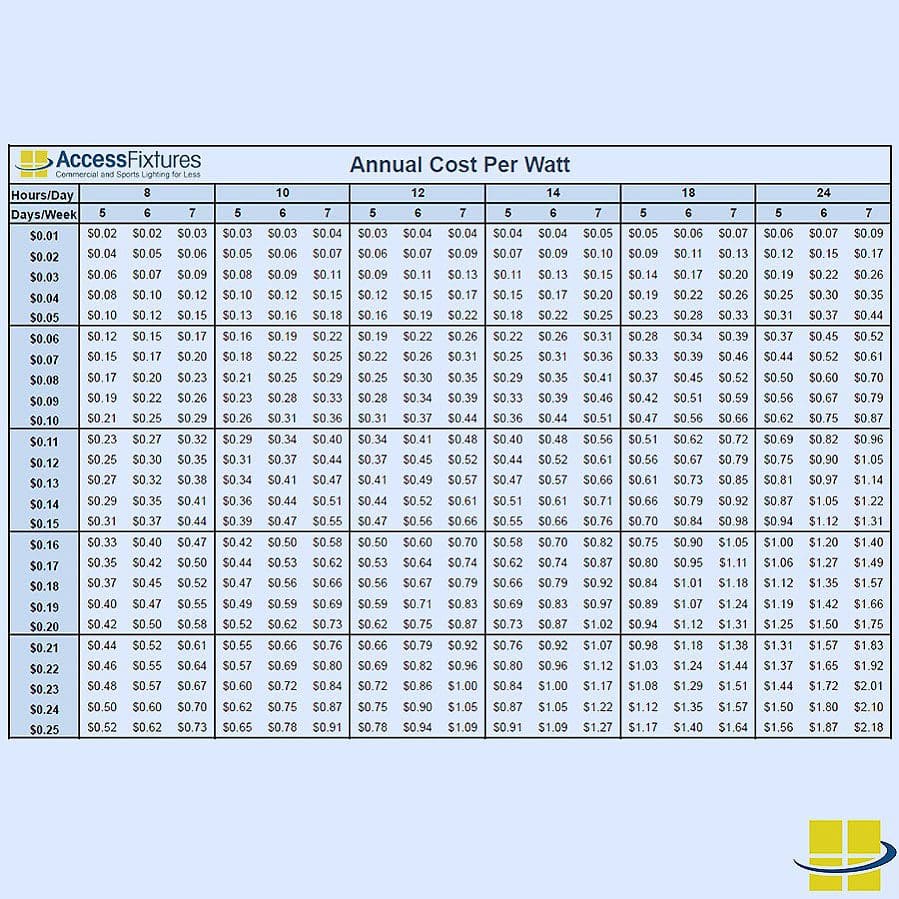
- Scan down the left column and locate your cost per kWh.
- Scan to the right to find the appropriate “Hours/Day” column.
- Within that column, find the correct days of operation per week (5, 6, or 7). The cell that lines up with both the cost-per-kilowatt-hour row and the “Hours/Day” and “Days/Week” columns is your operating cost per watt per year.
- Multiply the operating cost per watt per year by the total watts used by the light fixture.
- You have calculated the light fixture electricity cost for that luminaire.
The best way to lower your energy bill is to find ways to decrease the electricity you consume, since your energy provider charges you for every kWh used each month.
An Example of Calculating the Annual Light Fixture Electricity Cost
We’ll now walk through an example. Let’s say you’re torn between two wall packs. Either way, both wall packs will be used seven nights a week for about eight hours each night, with each hour representing one hour of operation at a time. Both emit similar light, but with very different technologies; which will be the most electricity-efficient choice? Let’s find out.
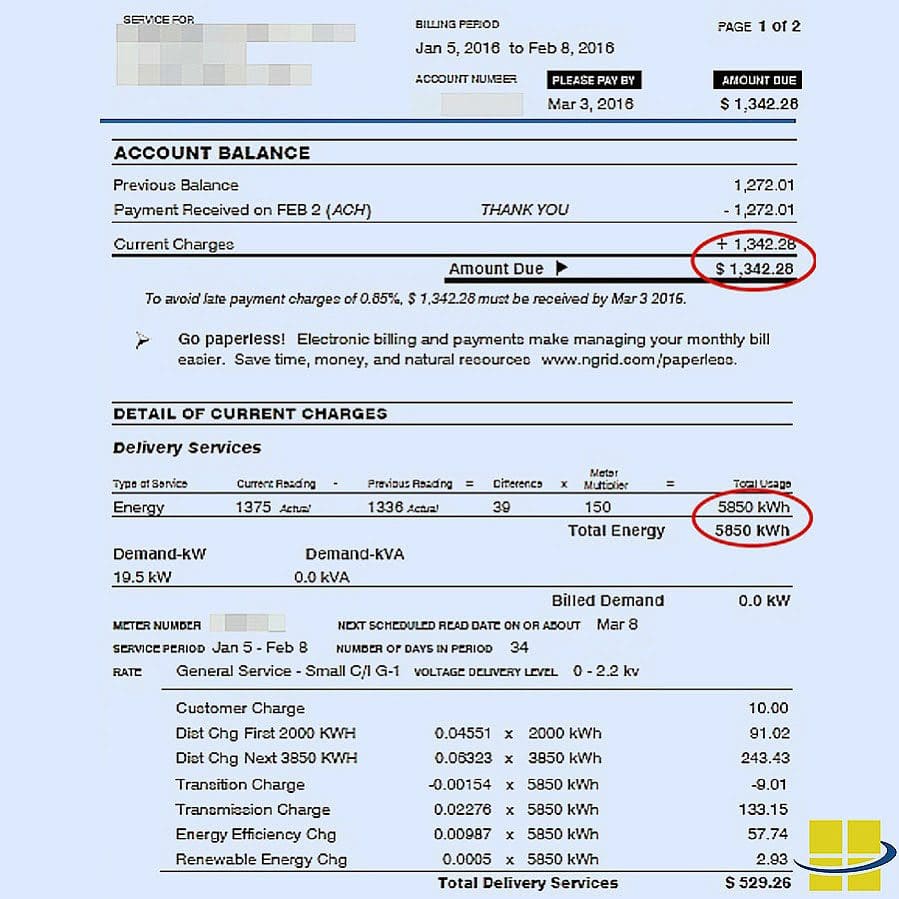
- Find the cost of electricity from your monthly electricity bill. See the following sample electricity bill. Total cost (“AMOUNT DUE”) is $1,342.28.
- Find the total number of kilowatt-hours used on your invoice. On the invoice below, “Total Energy” is 5,850 kWh.
- Divide the total cost of electricity by the kilowatt-hours. $1,342.28 / 5,850 = .23
- You have now solved for the cost per kWh. Electricity at this location costs $0.229, which we can round up to $0.23/kWh.
- Scan the left column of the “Annual Cost Per Watt” chart to find your cost per kWh. $.023 is the third-to-last row.
- Scan to the right to find the appropriate “Hours/Day” column. The wall pack will be used for eight hours a day. This calculation is based on how much power is used over the total hours of operation.
- Within that column, find the correct days of operation per week (5, 6, or 7). The cell that lines up with both the cost per kilowatt-hour row and the “Hours/Day” and “Days/Week” columns is your operating cost per watt per year. The wall pack will be used seven days a week. Our operating cost is $0.67 per watt, per year.
- Multiply the operating cost per watt per year by the total watts used by each light fixture. For a PSMH wall pack: $0.67 x 150 = $100.50. For an LED wall pack: $0.67 x 21 = $14.07
- To calculate kWh for each fixture, multiply the wattage by the number of hours used to get the total watt-hours, then divide by 1,000 to convert to kilowatt-hours (kWh). For example, a 150-watt fixture used for one hour consumes 150 watt-hours, or 0.15 kWh.
- You can use this method to calculate your approximate monthly kWh usage by multiplying your daily kWh usage by 30 days.
- You have calculated the cost of electricity per year to operate a luminaire. The LED wall pack will be $86.43 less expensive per year than the MH wall pack.
Cost per Watt Calculator
Do you know how much you’re spending on energy? More importantly, how much money are you losing each year? By switching to more energy-efficient lighting like LED wall packs or LED bollards, you could help lower your light fixture electricity costs.
Different rates may apply depending on your electricity plan, geographic location, and the time of day or year.
Variable-rate plans fluctuate monthly based on market conditions and seasonal demand, while Time-of-Use plans charge higher rates during peak hours and lower rates during off-peak times. Prices for electricity can spike in summer and winter due to increased demand for heating and cooling.
By taking the above steps, you can begin to calculate how much you’re spending each year. For example, energy is priced at approximately $0.15 per kilowatt-hour in the Boston area. A walkway in a commercial area has 15 bollards equipped with 70-watt metal-halide lamps and ballasts. If the luminaires are on seven days a week for ten hours a day, it would cost $0.55 per watt and $577.50 in total annual costs.
Geographic location affects electricity rates due to local regulations and fuel availability, so you should consider location, time-of-use, and total consumption when determining your cost per kWh.
But what if they decide to switch to LED lighting? The same bollards are equipped with 15-watt LED modules and drivers, which emit about the same amount of light. If the luminaires are on seven days a week for ten hours a day, it would still cost $0.55 for each watt but would only amount to a total annual cost of $123.75. For each year they delay switching to efficient lighting, they’re losing $453.75 only on the bollards!
Demand Charges and Power Factor for Commercial Lighting
Commercial electricity bills often include demand charge fees based on the peak power draw during the billing period in addition to the per-kWh energy charge. For facilities with large lighting systems, demand charges can represent a significant portion of the total bill.
LED fixtures with high power factors (0.90 or above) draw current more efficiently than those with low power factors, reducing the reactive power that contributes to demand charges. When specifying LED fixtures for a commercial facility, confirm the power factor rating. Access Fixtures LED fixtures are specified with power factor data available on each product page. Call 800-468-9925 to discuss power factor requirements for your facility.
Speak to an Access Fixtures Lighting Specialist about Choosing the Right Fixture
Access Fixtures is your factory-direct source for all light fixtures needed to suitably illuminate your property. If you have a lighting question or still need help finding your light fixture electricity cost, we will be glad to answer your questions. We want to make sure you get the exact fixture for your needs, your budget, and your goals. We are passionate about lighting and love what we do. We’ll get you an answer. To speak with an Access Fixtures lighting specialist, call 800-468-9925.
Conclusion
Calculating the annual electricity cost of a light fixture gives you a number that makes the LED upgrade decision straightforward. The worked example above shows an $86.43 annual saving per fixture switching from a 150-watt metal halide wall pack to a 21-watt LED replacement. Across a facility with 50 wall packs, that is over $4,300 per year — before factoring in maintenance, lamp replacements, and ballast costs avoided.
Use the calculator at the top of this page to run the numbers for your specific fixtures. When you are ready to specify the right LED replacement, call an Access Fixtures lighting specialist at 800-468-9925 or request a photometric analysis for your facility.
Frequently Asked Questions (FAQs) About Calculating Electricity Costs and Usage
What is the best way to calculate the cost of electricity per kWh?
To calculate the cost of electricity per kWh, divide the total cost of your electricity bill by the total kilowatt-hours (kWh) consumed during the billing period. This includes all charges such as customer fees, taxes, and delivery fees for an accurate cost per kWh.
How can I estimate the electricity usage of a light fixture?
Multiply the fixture’s wattage by the number of hours it operates per day to get watt-hours, then divide by 1,000 to convert to kilowatt-hours (kWh). Multiply this by the number of days used to estimate monthly or annual usage.
What factors affect the annual electricity cost of a commercial light fixture?
Four factors determine annual fixture electricity cost: fixture wattage, hours of operation per day, days of operation per week, and your electricity rate per kWh. The calculator at the top of this page calculates all four. For commercial facilities, demand charges and power factor also affect the total electricity bill; confirm the power factor rating of any fixture you are specifying.
How do I reduce electricity costs across a large commercial lighting system?
The most effective steps are replacing high-wattage HID fixtures with LED equivalents, adding occupancy sensors or daylight controls to reduce operating hours, and confirming that replacement fixtures have high power factors (0.90 or above). An Access Fixtures lighting specialist can calculate the projected annual savings for your specific fixture count and operating schedule. Call 800-468-9925.
What are demand charges, and how do they affect my bill?
Demand charges are fees based on your peak power usage during a billing period and often affect businesses or homes with high short-term power draws. Managing peak usage and improving power factor can reduce these charges.
Why do electricity rates vary by location and time?
Electricity rates differ due to local regulations, fuel costs, market structures (regulated vs deregulated), and time-of-use pricing that charges different rates depending on when energy is consumed.
How long do LED light fixtures typically last compared to traditional lamps?
LED fixtures can last over 100,000 hours, significantly longer than traditional lamps, which may last 10,000 to 15,000 hours, resulting in substantial savings on replacement and energy costs.