Solar LED Lighting · Walkway Guide
Best Solar Lights for Walkways
The best solar lights for walkways light building approaches, sidewalks, entrances, and storefront walks without trenching to every fixture. On commercial properties, walkway lighting has to guide visitors, mark hazards, and stay dependable through winter, not just look good on a summer night.
Well-placed walkway lighting helps people follow walking routes, recognize changes in elevation, and move comfortably from parking areas to doors. Solar walkway lights are a practical alternative to wired systems: they collect energy during the day and use stored power after sunset, with no electrical connection at each fixture. Their performance depends on sunlight exposure, battery capacity, weather, and the illumination required, so on commercial properties durability and consistent performance matter as much as appearance. Choosing the right commercial solar lights means evaluating walkway dimensions, light distribution, mounting, operating hours, and maintenance.
What Makes Solar Pathway Lights a Good Choice?
Solar pathway lighting illuminates walking routes without installing underground wiring. Each self-contained unit includes a photovoltaic panel, rechargeable battery, LED light source, and automatic controls. During daylight the panel converts sunlight into electricity and stores it; when ambient light drops, the fixture switches on automatically. That makes solar powered walkway lights especially useful where trenching would cut finished paving, curbs, or landscaped beds around an occupied building.
Where solar walkway lights work best
- Building approaches and entrances: light the route from parking to the front door without cutting into finished sidewalks.
- Storefronts and retail walks: add light to the steel safety bollards that already line the sidewalk.
- Loading docks and service walks: mark pedestrian routes near trucks and doors where power is far away.
- Campus and office sidewalks: connect buildings, plazas, and lots across lawns and utilities.
- Remote or temporary walkways: construction detours and seasonal walks where extending service is impractical.
Solar isn't equally suited to every walkway. Dense tree cover, tall adjacent buildings, deep overhangs, and extended cloudy weather limit charging, so a fixture that works along an open sidewalk may struggle in a shaded courtyard. For walkways used regularly after dark, illumination must suit the route's purpose: a decorative glow marks an edge but doesn't light the walking surface.
Planning an Outdoor Solar Walkway Layout
A good lighting layout begins with the walkway itself. Width, surface, surrounding vegetation, and nighttime use determine where fixtures go. A narrow side path may need subtle edge markers, while a sidewalk connecting buildings, parking, and public entrances needs broader, more consistent coverage.
Assess sunlight and seasonal shade
Check each proposed location at different times of day. Trees, roof overhangs, fences, and nearby structures create shade even where a walkway looks open, and lower winter sun angles and shorter days reduce charging. On larger properties, evaluate the entire route to find sections where solar works and sections where a wired fixture makes more sense. Access Fixtures lighting specialists size walkway systems for the site's shortest winter days.
Position lights around actual walking routes
The most attractive arrangement isn't always the most functional. Uniform spacing looks tidy, but curves, stairs, ramps, intersections, and door approaches need closer placement. Fixtures should direct light onto the walking surface without uncomfortable glare. Spacing depends on mounting height, distribution, output, and surface: dark asphalt, pale concrete, and pavers reflect light differently, so the same layout won't perform identically everywhere.
Consider mounting and surface conditions
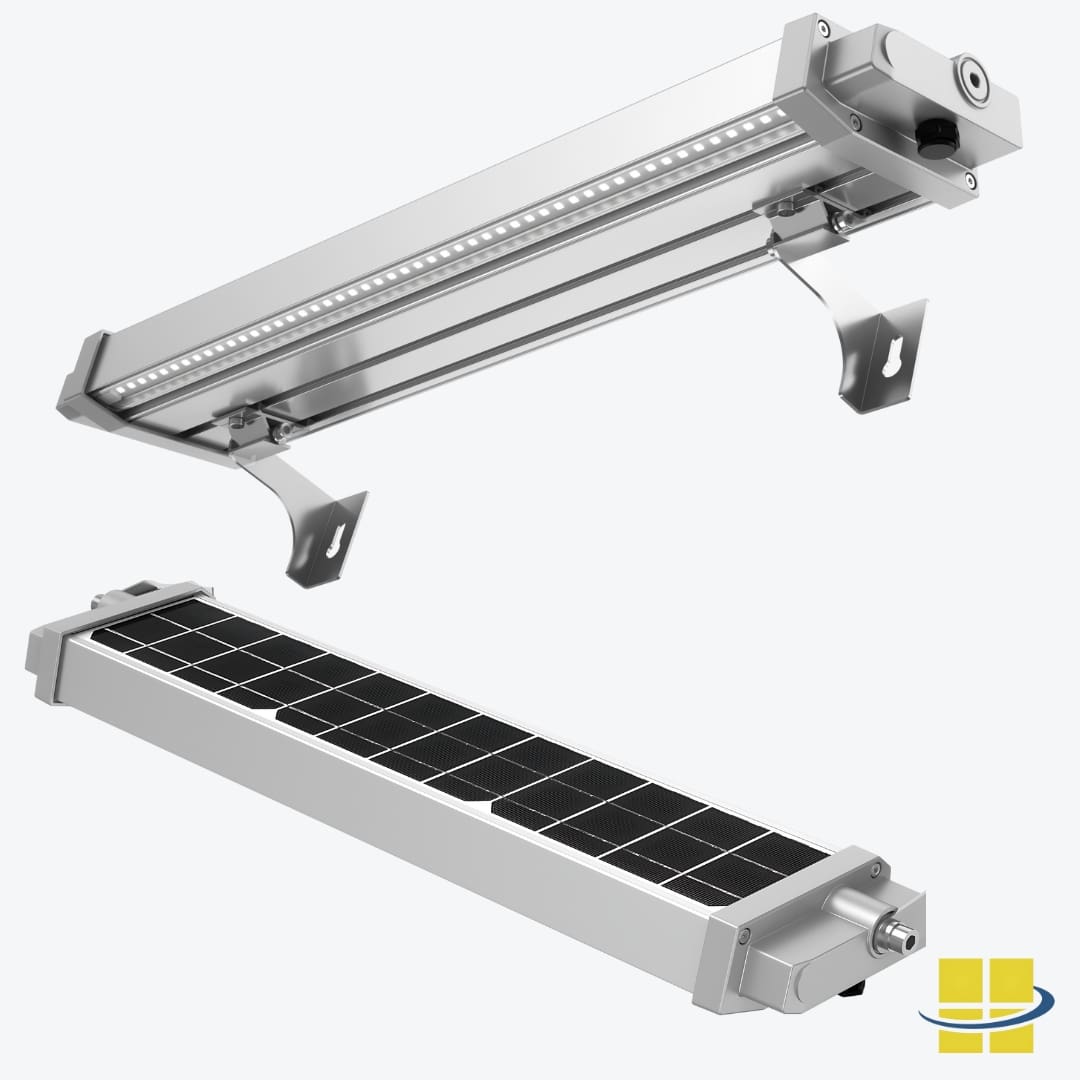
Walkways next to buildings offer three mounting options. Wall-mounted fixtures keep the walking surface clear: WULI solar wall packs mount on the building face, and their pivoting head directs light down onto the walk, outward, or onto the wall. Bollards define edges and separate pedestrians from traffic. Where concrete-filled steel bollards already protect a storefront or entrance, SECU solar security bollard lights slide over a concrete-filled 5" Schedule 80 steel pipe (5.563 in OD) and turn each bollard into a lit post. SECU adds light only; the steel bollard and its footing provide the vehicle protection. Products designed for garden beds should never be installed in pedestrian or vehicle-bearing surfaces.
Walkway lighting planning checklist
| Site consideration | What to check | Why it matters |
|---|---|---|
| Sunlight exposure | Trees, buildings, overhangs, seasonal shade, panel position | Determines available charging energy |
| Walkway dimensions | Width, length, corners, intersections, ramps | Influences fixture spacing and distribution |
| Surface and mounting | Concrete, pavers, building face, existing bollards | Determines wall, bollard, or retrofit mounting |
| Pedestrian activity | Traffic levels and nighttime operating hours | Sets required illumination consistency |
| Weather exposure | Rain, snow, coastal air, temperature changes | Drives housing construction and IP rating |
| Electrical access | Available power and installation disruption | Decides solar, wired, or a combination |
A measured layout reduces uneven illumination, unnecessary purchases, and maintenance problems.
How Bright Should Solar Walkway Lights Be?
Brightness is one of the first specifications to examine, and light output is measured in lumens. The number alone doesn't show how effectively illumination reaches the walkway: a compact decorative fixture creates a pleasant pool of light beside a garden border but leaves dark areas across a wider commercial sidewalk.
Decorative lighting vs functional visibility
Low-output lights work when the purpose is to mark a path's direction or complement landscaping. Functional walkway illumination needs attention to coverage: a commercial route serving employees, visitors, or customers needs consistent visibility across the walking surface. The right output depends on mounting height, distribution, route width, nearby lighting, and the property's requirements. Rather than choosing the brightest fixture available, compare how each option distributes light; a properly directed LED luminaire lights the walking surface without an excessively bright point at eye level.
Choosing warm white or neutral white
Warm white complements brick, stone, planting, and traditional architecture, and it suits hospitality properties. Neutral white suits contemporary buildings, commercial entrances, and routes where a cleaner look is wanted. Avoid mixing noticeably different color temperatures along one route. SECU is available in 3000K, 4000K, or 5000K, or in 590nm amber where wildlife protection applies.
Why light distribution matters
A bright fixture isn't necessarily a well-performing one. Optics determine where light falls, how widely it spreads, and whether pedestrians see glare. A narrow beam may light the area beneath the fixture and leave surrounding pavement dark, while a broader distribution at the correct height gives smoother coverage. Full cutoff, low-uplight optics also keep walkway lighting dark sky friendly; SECU carries a B0-U1-G0 BUG rating. For routes connecting buildings, plazas, and parking areas, photometric planning confirms placement and coverage before installation.
The best walkway light is the one visitors don't notice: even light on the walking surface and no glare in their eyes.
Solar Light Performance, Weather Resistance, and Maintenance
Solar walkway lighting depends on several components working together: the panel collects energy, the battery stores it, the LED produces light, and the controls set operating times. Evaluate a product as a complete system rather than by advertised brightness.
Can solar lights operate all night?
Properly sized fixtures run dusk to dawn, but runtime depends on battery capacity, LED load, controls, and charging conditions. WULI needs just 4 hours of daily charging for full-night operation in its rated configuration. Short winter days, overcast weather, snow, and shade still reduce available energy, and cold can affect battery performance. For walkways that need dependable dusk-to-dawn light, review operating-hour specifications against your winter conditions, not summer results. Our guide to the best solar lights for pathways covers winter sizing for longer park and campus routes.
Choosing weather-resistant construction
Moisture resistance, housing material, lens protection, and secure mounting all deserve attention, and a coastal walkway exposed to salt air has different demands from a sheltered courtyard. Low-grade plastic housings deteriorate with repeated outdoor exposure, while aluminum construction supports demanding applications. Check every product's actual IP rating rather than general weather-resistance claims: WULI and SECU are rated IP66, which per IEC 60529 means dust-tight and protected against powerful water jets.
Battery replacement and serviceability
Batteries and electronics eventually need attention. Commercial fixtures use LiFePO4 batteries; WULI's are rated for 3,000 to 5,000 depth-of-discharge cycles. Before purchasing, review maintenance instructions, replacement-part availability, and warranty coverage. Access Fixtures solar fixtures carry a 5-year warranty. A practical routine includes:
- Clean solar panels regularly to remove dirt, leaves, and debris.
- Inspect fixtures and mounting points for movement, moisture damage, or vegetation shading the panel.
- Monitor nighttime performance and check the battery when brightness or operating hours decline.
Solar vs Wired LED Pathway Lighting for Commercial Properties
Solar and wired systems serve different needs. Solar reduces electrical installation work where sunlight is available, while wired LED lighting needs power infrastructure but runs independently of daily charging. Neither is automatically better for every walkway.
Installation cost and long-term value
Solar avoids trenching and electrical connections at each fixture, which matters around finished paving, curbs, and occupied buildings, and it removes ongoing electricity bills. Total ownership cost also includes cleaning, battery replacement, and durability. Wired installations need transformers or branch circuits, cable, weather-rated connections, and routing around utilities. The solar vs low-voltage landscape lighting calculator compares both, including payback period.
When to combine solar and wired lighting
Many commercial sites use both: solar on open sidewalks, bollard lines, and walks far from power, and wired fixtures in deeply shaded courtyards or where circuits already exist. That split gives each section of the route the right power source. For a full comparison, read solar lighting vs traditional outdoor lighting.
Retail Solar Kits vs Commercial Lighting
Retail solar kits suit a residential garden or yard where easy installation and appearance are the priorities. Commercial walkways need closer evaluation of performance, construction, and maintenance: an office campus or retail center needs coordinated fixture spacing, durable housings, and dependable operation. Purpose-built LED solutions let those requirements shape the selection instead of working around the limits of a decorative product.
WULI Solar Wall Packs
5W or 10W, pivoting head, IP66, L70 at 270,000 hours, full night from 4 hours of charging.
Shop WULISECU Solar Security Bollard Lights
Lights concrete-filled 5" Schedule 80 steel bollards. IP66, IK07, B0-U1-G0.
Shop SECUChoosing Walkway Lighting That Fits the Property
The right outdoor lighting matches the route, environment, and illumination required. Consider light distribution, battery performance, construction, and maintenance before choosing a product, and on commercial properties give consistent coverage and long-term reliability the most weight. Access Fixtures provides production and built-to-order solar LED lighting for walkways, plazas, campuses, storefronts, and hospitality properties, and offers photometric studies to evaluate proposed layouts before installation.
Frequently Asked Questions
What are the best solar lights for commercial walkways?
Wall-mounted solar fixtures and bollards suit most commercial walkways. WULI solar wall packs mount on the building and direct light onto the walk, and SECU adds solar light to existing concrete-filled steel safety bollards. Both are rated IP66 with L70 at 270,000 hours.
Can I add lights to existing security bollards?
Yes. SECU solar security bollard lights slide over a concrete-filled 5" Schedule 80 steel pipe (5.563 in OD) with no trenching or wiring. SECU adds light only; the steel bollard and its footing provide vehicle protection.
How much sun do solar walkway lights need?
It depends on the fixture and the battery. WULI needs about 4 hours of daily charging for full-night operation. Size every system for the site's shortest winter days and check shade from buildings and overhangs.
Are solar walkway lights dark sky friendly?
They can be. Choose full cutoff optics, low uplight, and warm color temperatures. SECU carries a B0-U1-G0 BUG rating.
Light Your Walkway with Access Fixtures
Send your walkway layout, mounting options, and operating hours, and an Access Fixtures lighting specialist will match solar fixtures to your site.
Sources: WULI figures from Access Fixtures product pages; SECU figures from the SECU product guide and engineering and installation guide (v261028), November 2026. Ingress protection per IEC 60529.